Chapter One
The Bastard and His Sister
Scott ordered a dog.
Not rescued. Not adopted. Not “found on the side of the road” or “showed up one day and never left” or any of the origin stories that make you sound like a good person at dinner parties. Scott paid a deposit, got on a waitlist, and waited for his number to be called, the way you’d order a sofa from a catalog if the sofa took four months to gestate and came out covered in fur.
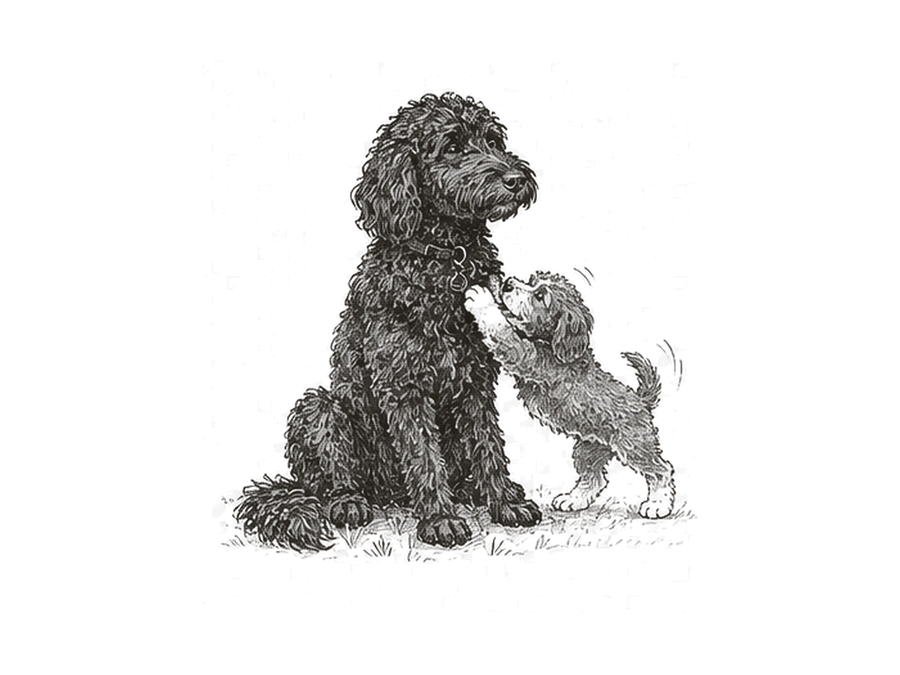
Abby was about two at the time. Goldendoodle. Dignified in the way that only a creature who has never questioned her own worth can be. The family decided she needed a playmate, because a single dog in a house with two kids and a grandmother and a wife and a CEO who works from the white sofa is apparently not enough chaos. More was needed. More was ordered.
The waitlist moved the way waitlists move — slowly, with occasional emails from the breeder containing photos of dogs that were not yet Scott’s dog, which is the puppy equivalent of a restaurant texting you pictures of other people’s entrees while you wait for a table. Scott’s number was not called. Scott’s number continued to not be called. That was fine. These things take time. Scott is patient in the way that a man who wakes up at 4 AM to sit on a dog’s sofa is patient — selectively, and with the quiet conviction that the universe is processing his request.
Then came January 2nd.
The trail is in a valley on the windward side of the island. It’s a hiking trail, the kind where hikers hike, which is what trails are for. It is also, as it turns out, a trail that pig hunters traverse to reach the pig hunting grounds deeper in the valley, and the pig hunters bring dogs, and the dogs are pit bulls, and the pit bulls are trained to do one thing, which is find pigs and pin them down, and on January 2nd, six of these dogs found Abby and made a professional assessment that was incorrect.
Abby is not a pig. This will later be confirmed on the record, in a courtroom, on taxpayer dollars. But the dogs did not have this information at the time.
Six pit bulls pinned Abby to the ground. Scott screamed. Not a masculine scream. Not a battle cry. Not the scream of a man who is about to do something heroic. Scott screamed like a seven-year-old girl, which would have been embarrassing except that the actual seven-year-old girls — Carina and Emily — stood by in silent horror, making no sound at all, which means the adult and the children had swapped roles entirely and nobody had time to notice.
Ai intervened. Ai got bitten — badly. She wouldn’t testify to this in court, and she certainly wouldn’t tell you this at the time, but she’ll tell you now, years later, in the kitchen, with the kind of calm that only comes from having fully processed a thing you once couldn’t talk about: she’s pretty sure Abby bit her. Not the pit bulls. Abby. In the chaos, in the panic, in the tangle of jaws and fur and adrenaline, her own dog bit her by mistake.
She thinks this is why she’s Abby’s person.
She thinks Abby has been making up for it ever since. All of it — all of Abby’s quiet, dignified, unshakeable loyalty — is, in Ai’s theory, a six-year apology for one bite on a hiking trail that neither of them has ever discussed because dogs don’t discuss things and Ai is not the kind of person who needs them to.
Scott called the cops, because that’s what you do. You don’t confront. You don’t escalate. You call the authorities and let the system handle it, which the system will do, eventually, imperfectly, and on its own timeline.
An ambulance took Ai away.
Scott’s friend Doug took Abby to the vet. She had a gaping hole in her hind leg. She was still walking. She was still wagging. This is either the bravest thing a dog has ever done or the most Abby thing Abby has ever done, which might be the same thing.
Scott took the girls to Aunty Lani’s house. Then he went to the ER for his own injuries. And with his barely workable thumbs, wrapped and swollen and probably still shaking, he texted the doodle breeder: going to have to put off the purchase for a while.
The breeder was understanding. The breeder continued to email every time a new litter was born. Scott continued to reply: not ready yet.
Not ready yet. Not ready yet. Not ready yet.
The breeder mentioned, at some point, that if Scott didn’t pick one this year, the price would go up. Scott said that’s fine. The price could go up. Scott wasn’t ready. The family wasn’t ready. Abby’s leg had healed but the family had not, and there is no veterinary science for a household that flinches at the sound of barking from two blocks away.
But there was an advantage to the delay: every time Scott didn’t get a dog, his position on the waitlist moved up. One by one, the families ahead of him selected their puppies and went home and Scott’s name rose like a man who got into law school at thirty-nine and graduated top of his class — not by being the smartest, but by being the one who was still there when everyone else had already picked their dog and left.
He was number one on the waitlist. Top of his class. Again.
Months after the attack and before the dog that would eventually come, there was the matter of the courtroom.
First District Court, Honolulu. The defendant was the owner of the pit bulls. The charge was whatever the charge is when six of your dogs mistake a goldendoodle for a pig on a public hiking trail, which turns out to be a thing the legal system has an opinion about, though not a particularly decisive one.
A defense attorney — a nice young man, competent, doing his job — stood up and asked Scott a question.
“Is it possible the dogs mistook Abby for a pig?”
Scott had watched enough lawyer shows. Scott had, in fact, watched all of them. He knew what this question was doing. He knew the door it was trying to open. He also knew that on cross-examination, you answer the question you were asked and nothing more, because anything more is a gift to the other side and Scott is not in the business of giving gifts to people who are defending the owners of dogs that put a hole in his dog.
“Anything’s possible, counselor.”
On redirect, the prosecutor stood up. The prosecutor looked at Scott. The prosecutor asked a question that is now archived in the annals of the First District Court of Honolulu, preserved for posterity, funded by the taxpayers of the State of Hawaii:
“Is Abby a pig?”
“No,” Scott said. “She’s a dog.”
The defendant got off on a technicality. This happens. Scott was not bitter about it in the way that a person who understands the legal system is not bitter about the legal system — he’s disappointed, but he respects the architecture even when the architecture fails. After the statute of limitations expired, Scott contacted the nice young defense attorney and told him he did a great job. Because Scott respects the craft. Win or lose. The profession deserves professionals, and this one was professional, and Scott thought he should know.
The nice young man was surprised. He said thank you. He also said: “You’re the first witness who’s ever quoted verbatim a statute from the stand.”
Of course he had.
The dog attack was the last in a series of things that made Scott decide, at age thirty-nine, to go to law school. He wrote a paper on the criminal and civil aspects of his own dog’s mauling, received an A+, and graduated top of his class. Scott is not a lawyer. Scott has never practiced law. But Scott now knows things, and the knowing was the point, and all of it — the courtroom, the paper, the degree, the A+ — traces back to a twenty-five-year-old kid on a hiking trail who either didn’t know or, quite more likely, didn’t care about the Hawaii Administrative Rules.
Abby’s scar healed. The family’s did not. Not fully. Not in a way that would ever let them send a dog into the world with someone else again.
Before the attack, Abby’s training had consisted of Scott’s friend Duncan — an unemployed Silicon Valley tech entrepreneur turned dog trainer, because Silicon Valley produces two things: apps and career pivots — picking her up in a big beat-up van with ten to twelve other dogs and taking them on hiking trails and beaches where she learned how to behave in a pack. This ran for a few months until Covid, and then the attack happened sort of during Covid, and after that, this family would never send a dog on a trail or a beach with anyone, dog trainer or otherwise.
This meant that when the new dog eventually came, the new dog would get no formal training at all. None. Zero. The family’s unresolved trauma became the new dog’s freedom. Their fear became his kingdom. And the logic, unspoken but universally understood, was simple: a dog on the dining room table is one fewer dog in the dog ER.
The bastard would get the run of the house.
They just didn’t know he was the bastard yet.
Fourth of July, 2023. The family was in Japan, at Ai’s sister’s apartment in Kyoto, doing the thing they do every summer — expanding into the novelty, plateauing in the heat, and beginning the slow contraction toward wanting to go home. Scott’s phone buzzed. An email from the breeder. A new litter. Photos attached.
Scott showed the photos to Ai.
“Do you think it’s time yet?”
She looked at the photos. She looked at Scott.
“Yeah.”
So he told the breeder: let’s roll.
Weekly photos arrived via email. The puppies grew the way puppies grow — imperceptibly, then suddenly, then in a way that makes you wonder how something that small became something that large in what felt like four emails. Late August, it was time. And as number one on the waitlist — top of his class, again, always — Scott had pick of the litter.
The whole family drove forty minutes to the windward side of the island. Ai. Scott. Carina and Emily, who were excited in the way that you’re excited to get a new dog when your recently new dog is only four years old and everything is still new and cute and fun. They arrived. They entered the pen.
The pen was chaos. Puppies everywhere. Climbing on each other. Climbing on the family. Yipping, tumbling, performing for the audience the way puppies perform for every audience, which is with full commitment and zero dignity. Every puppy in that pen was auditioning. Every puppy was saying pick me, pick me, pick me.
Every puppy except one.
Near the edge of the pen, away from the chaos, away from the auditions, away from the yipping and the tumbling and the desperate performance of cuteness, a puppy was asleep. Not pretending to sleep. Not resting between performances. Asleep. Fully, completely, utterly asleep, in the way that only a creature who does not give a single shit about your selection process can be asleep.
Tuesday Person energy.
They just didn’t know yet that he hadn’t found his dining room table.
The family chose him. Or he chose himself, which is what it looked like — a puppy who opted out of the audition and got the part anyway, the way certain people opt out of trying and succeed precisely because they weren’t trying, which is infuriating if you’re a puppy who was auditioning your heart out and didn’t get picked.
Murphy went home with them.
The ride home was forty minutes of chaos in the backseat. Carina and Emily fought over who got to hold him, which is a fight that has no winner because a puppy is not a resource to be allocated, it is a creature that will pee on whoever is holding it and the only question is who gets peed on first. Scott drove the car and tried to drive it straight while staring into the rearview mirror at a puppy he’d waited two years for and a backseat full of children who were already in love with something that had been theirs for eleven minutes.
At home, Abby was waiting.
Abby had not been consulted about this decision. Abby had not reviewed the photos from the breeder. Abby had not been part of the family meeting in Sayo’s apartment in Kyoto when the word “yeah” changed the household composition. Abby was a four-year-old goldendoodle who had been mauled by six pit bulls, recovered with dignity, established herself as the queen of the white sofa, and was now being informed — by the sudden presence of a small, sleeping intruder — that the monarchy had been disrupted.
The betrayal was immediate. The invasion was unforgivable.
Who the fuck are you?
She snubbed him. She growled. She snapped, then walked away, which is the Abby version of a diplomatic protest — formal, brief, and followed by a strategic withdrawal to higher ground. The white sofa. Her sofa. The one place in the house that was unquestionably hers.
Murphy, of course, followed her.
This was the beginning of weeks, then months, of cold war. Abby enforced boundaries. Murphy ignored them. Abby growled. Murphy persisted. Murphy found T-Rex — the two-foot-tall plush dinosaur that was Abby’s favorite destruction toy — and claimed it, because Murphy’s first act in any new environment is to locate the thing that matters most to someone else and make it his. She’d fight him for it. She’d win, because she was four times his size. But he didn’t give up. He’d find it again. He’d take it again. He knew. Somehow, immediately, instinctively, he knew which toys were hers and which were the kids’ favorites and he chose those over the ninety-nine other options in their room, because Murphy has never in his life taken the path of least resistance when the path of most resistance was available.
Eventually, Abby stopped trying to enforce boundaries. The way Scott eventually stops trying to enforce his. The way anyone stops trying to enforce anything with Murphy. You don’t win. You don’t lose. You just get tired of the negotiation and accept that the labradoodle is going to do what the labradoodle is going to do and the energy required to stop him exceeds the energy required to let him.
She hasn’t growled at him in over a year. They are friends now. Not the kind of friends who talk on the phone for two hours. The odd-couple kind. The kind who coexist because that’s the situation they’re in, and probably wouldn’t have it any other way, though neither of them has said this out loud because one of them can’t talk and the other one won’t.
The dining room table.
Every household has a piece of furniture that belongs to one creature and everyone knows it. In this house, the white sofa belongs to Abby. The massage chair belongs to Ai. The loveseat near the garage belongs to whoever was most recently evicted from the white sofa by a child who needs the big TV to watch a stranger play a video game.
The dining room table belongs to Murphy.
It didn’t always. The dining room table was, at one point, a dining room table — a flat surface where food was served and meals were eaten and the family gathered in the way that families gather, which is imperfectly and with phones. Then Murphy turned about one, and became spry enough to get up on it, and got up on it.
Everyone tried to get him off.
Scott tried. Ai tried. The kids tried. Grandma, who has been running households longer than anyone in this one has been alive, tried. Murphy would get off. Murphy would then get back on when nobody was looking. He’d be removed. He’d return. He’d be removed again. He’d return again. The cycle repeated with the inevitability of a tide coming in — you can stand at the shore and push the water back and the water will retreat and then the water will come back and eventually you will get tired and the water will be where the water wants to be.
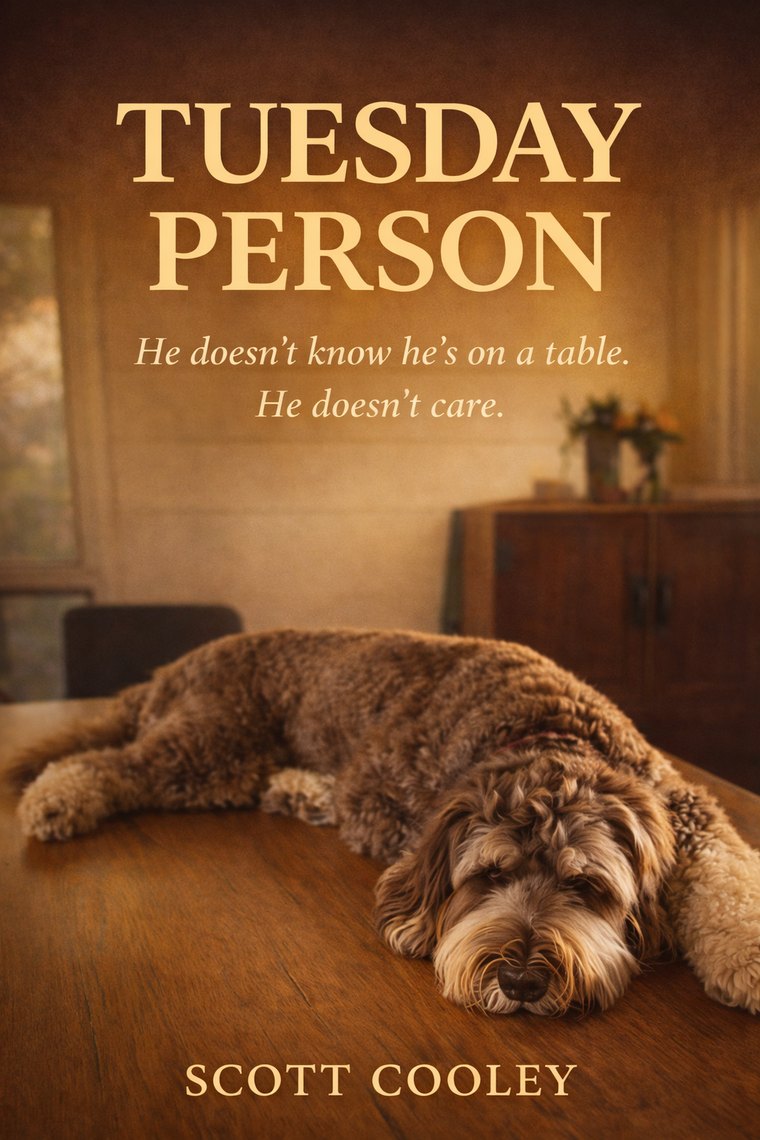
Murphy is on the dining room table.
Nobody remembers when they stopped trying. Nobody can point to the specific dinner when the family looked at the dog on the table and collectively decided that this was now a feature of the household rather than a problem. It just happened. The way all surrenders happen in this house — not with a formal agreement, but with the quiet exhaustion of people who have learned that Murphy’s commitment to any position exceeds their commitment to opposing it.
He sleeps there. He surveys the kitchen from there. He watches the family from a vantage point that no dog should have and no family should allow and everyone has accepted because the alternative — an endless, unwinnable campaign of dog removal — was more exhausting than just letting the bastard have the table.
A dog on the dining room table is one fewer dog in the dog ER.
That’s the math. That’s the deal. That’s the unspoken contract between a family that was traumatized by what happened on a hiking trail and a dog who was not there for any of it but benefits from all of it. Murphy’s kingdom was built on Abby’s misfortune. His freedom was purchased with their fear. And the table — the throne, the perch, the place where the bastard surveys his domain — is the physical manifestation of a family that decided, without ever saying it out loud, that control was less important than safety, and safety meant letting the dog be wherever the dog wanted to be, even if where the dog wanted to be was on the furniture where they eat.
The stuffed animals.
There are, at last count, more stuffed animals in this house than in most toy stores. The kids have them. The dogs destroy them. This is the cycle. A stuffed animal enters the house with its stitching intact and its stuffing where stuffing belongs and within days — sometimes hours, depending on Murphy’s interest level — the animal is gutted, deflated, and missing an eye.
Murphy’s current prize is a stuffed cheetah. It was a souvenir from someplace Emily went. It is now Murphy’s cheetah. It lives in Emily’s bed, where Murphy lives, where the two of them engage in parallel play — she on Minecraft, he on the cheetah — in a scene of such complete mutual indifference that it could be mistaken for hostility if you didn’t know that this is what love looks like between a teenager and a labradoodle.
The cheetah has been destroyed. The cheetah has been mended. The cheetah has been destroyed again. This is where Grandma enters the story, not with a speech or a dramatic gesture, but with a thimble and thread.
Grandma mends the stuffed animals.
This is one of many things Grandma does in her spare time, which is all of her time, because Grandma is a career homemaker and a career homemaker’s work is never done, it just changes shape. Poor Sleepy Stitch — another stuffed casualty, another veteran of Murphy’s jaws — has had more surgeries than a gunshot victim in a trauma ward. Limbs reattached. Stuffing replaced. Eyes re-sewn. The patient keeps returning to the field and the field keeps sending him back to Grandma and Grandma keeps stitching him up because that’s what Grandma does. She holds things together. With thread. With patience. With the quiet, unshakeable competence of a woman who has been maintaining things longer than anyone in this house has been breaking them.
Murphy destroys. Grandma rebuilds. The cycle continues. Neither of them will stop. Neither of them sees a reason to.
Here is the household.
Scott, the CEO who pays for everything and ranks last in the hierarchy of creatures who live in his house. Ai, who runs the morning and the evening and the space between them with a precision that suggests she has always been in charge and Scott’s name on the deed is a formality. Carina and Emily, twins, teenagers, occupants of rooms filled with stuffed animals that exist in a constant state of surgical recovery. Grandma — Ai’s mother — at the kitchen table with her watercolors or her thimble, holding the house together one stitch at a time.
Abby, on the white sofa. Dignified. Healed. Still wagging, even after the thing that should have broken her. The queen who didn’t ask for a roommate and got one anyway and has, over the course of a year, stopped growling about it.
And Murphy. On the dining room table. Asleep, probably. Or surveying his kingdom from a perch he claimed through persistence and a family’s unwillingness to fight a war they knew they’d lose. The bastard. The one who was asleep in the pen while every other puppy auditioned. The one who didn’t try and got picked anyway. The one who chose himself.
He doesn’t know about the attack. He doesn’t know about the courtroom, or the pit bulls, or the gaping hole in Abby’s leg, or the ambulance, or Doug at the vet, or the statute Scott quoted from the stand, or the law degree that followed. He doesn’t know that his freedom — the table, the cheetah, the run of the house — was built on a thing that happened two years before he was born to a dog who sleeps six feet away from him and has never told him about it because dogs don’t tell and Abby wouldn’t even if she could.
He just knows the table is his. The house is his. The cheetah is his. Emily is his. And on the days when Emily is at school and the table is warm from the sun through the window, Scott is an acceptable second.
This is a book about what these two dogs know that Scott is still trying to learn.
Murphy chose himself.
Abby is still wagging.
Scott is telling you this from the far side of the hardest year of his life. The dogs were there for that too. That’s later.
Pay attention.
Chapter Two
The Tuesday Person
Scott used to think Tuesday People were losers.
He wouldn’t have said it that way. He would have said “unmotivated” or “content with mediocrity” or “not built for the arena,” all polite ways of saying the same thing: these people have no fire. These people wake up on a Tuesday and feel fine about it. These people are not chasing anything, which means they’re not going anywhere, which means they’re already where they’ll always be, which is right here, on a Tuesday, feeling fine.
A Tuesday Person is someone who doesn’t need Saturday to justify the week. The day is the day. The day is enough. A Saturday Person is someone who endures the week to earn the weekend, the trip, the reward, the thing that makes the other five days worth surviving. Scott was a Saturday Person for twenty-five years. He didn’t know there was another option.
Scott was twenty-two. He was bartending in Kyoto. He’d get off at 5 AM, sit on the riverbank as the sun came up, and watch the suits file across the bridge to their offices and the girls in school uniforms file to their schools and the whole city organize itself into neat rows of people doing the thing they were supposed to do on a Tuesday morning. And Scott would laugh. Actually laugh. Because those people were going to work and he was going home to sleep until 3 PM in an apartment that cost less than his bar tab, and he was living, actually living, and they were just... showing up.
Who’s the loser now?
He was. Obviously. He was making minimum wage pouring drinks for expats and sleeping through daylight and calling it freedom because it felt like Saturday every day. When every day is Saturday, no day is Saturday. It’s just unstructured time with a bartender’s income and the quiet conviction that the people in suits are missing the point.
They weren’t missing the point. They were the point. Scott just couldn’t see it yet because he was twenty-two and sitting on a riverbank at sunrise and the sunrise was beautiful and the conviction was strong and minimum wage doesn’t feel like minimum wage when you’re young enough to believe that money is a thing that happens to other people.
Twenty-two years later, Scott has the corner office. The seven monitors. The panoramic view. He has become the suit on the bridge, except the bridge is in Honolulu and the suit is golf pants and a quarter-zip because Scott is a CEO who works from a white sofa that belongs to a dog. He has done the thing the twenty-two-year-old on the riverbank was laughing at. He has showed up. Every Tuesday. For twenty-two years.
And somewhere around year ten, he started noticing the people he used to laugh at.
There’s a man — Scott won’t use his real name, so let’s call him what Scott called him for the first three years of knowing him: the World’s Boringest Man.
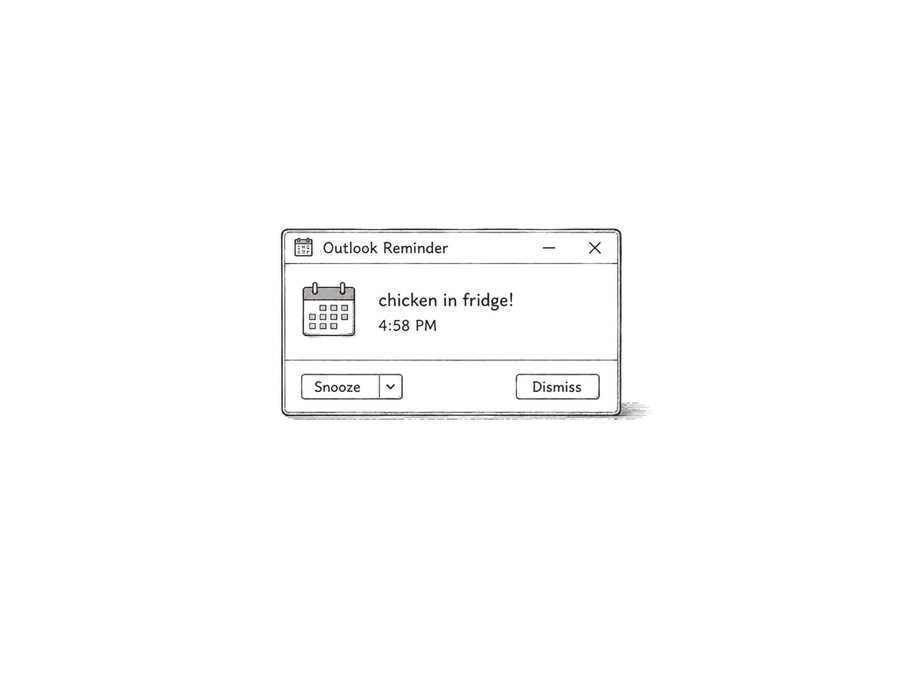
He’s the operations director at a large institution. Scott has known him for years through work that’s no longer worth describing. He has been in his role for longer than some of Scott’s employees have been alive. He puts Outlook reminders in his calendar about food in his fridge that needs eating. Not meetings. Not deliverables. Not quarterly reviews. Outlook reminders about leftover chicken.
He listens to music on wired headphones. Not because he can’t afford wireless. Because wired headphones work and he has a pair and they’re fine. He has a vinyl collection. Not because vinyl is trendy again. Because he bought the records thirty years ago and they still play and he still likes them and the system works.
He answers the phone like a normal person. Not with the clipped urgency of a man between fires. Not with the performative busyness of someone who wants you to know they’re important. He answers the phone and says hello and means it and gives you his full attention because you called and he’s here.
He executes with precision. He follows through. He does his job without dramatics, without chaos, without the operational adrenaline that Scott used to mistake for excellence. He is steady. He is reliable. He is, by every metric Scott spent twenty-two years optimizing for, boring.
Scott doesn’t call him the World’s Boringest Man anymore. They’ve become friends. And the friendship itself is a Tuesday thing — no fireworks, no intensity, just two guys who talk when they talk and don’t when they don’t and neither of them is keeping score.
They’re having dinner on Friday. Not drinks — drinks is what you do with someone you’re still performing for. Not coffee — coffee is what you do with someone you’re not sure you like yet. Dinner. Two grown men sitting across from each other in a restaurant without a labradoodle on the table, ordering food at a normal time like normal people, and talking about whatever it is friends talk about when neither of them is trying to get somewhere. Scott doesn’t know what they’ll discuss. He doesn’t have an agenda. He hasn’t pre-packed the conversation four days in advance. This might be the most Tuesday Person thing he’s ever done, and he’s trying very hard not to ruin it by noticing.
Scott admires him now. Not in the way you admire a sunset or a performance. In the way you admire a foundation. The man is poured concrete. He doesn’t shift. He doesn’t chase. He has Outlook reminders about chicken and he will eat that chicken on the day the reminder tells him to eat it and he will not, at any point, question whether eating leftover chicken on a Wednesday is the best use of his time on this planet.
It took Scott twenty years to understand that this is not a lack of ambition. This is the absence of war. The man is not bored. The man is at peace. And peace, from the outside, looks exactly like boredom if you’ve never experienced it.
Here is what Scott’s peak Saturday Person era looked like:
Weekdays, he was in the cockpit. Teaching flying lessons. Looking down. And every time the plane banked over Pearl City or Ewa Beach, he could see them — the golf courses. Green rectangles cut into the landscape like invitations. And he’d think: I should be down there. I’ll be down there Sunday. Sunday is the thing. Sunday is when the real living happens. This — the altitude, the airspeed, the student in the left seat who just nearly stalled the Cessna on the turn from base to final — this is the work. The golf course is the reward.
Then Sunday. On the golf course with Ai. Driver in hand. Looking up. And there they were — the planes. Crossing overhead. The sound of a Lycoming engine at two thousand feet, a sound Scott knows the way Murphy knows the sound of a cabinet opening, except Murphy hears dinner and Scott hears the sky.
I should be up there.
In the plane, he wanted the course. On the course, he wanted the plane. In neither place was he in the place. In both places, he was in the other place. Never here. Always somewhere else. The wanting was the only state that felt like living.
Arrested Saturday Development.
Murphy has never looked at the dining room table and wished he were on the white sofa. Murphy has never been on a walk and thought about the nap he’ll take after. Murphy is on the table. Murphy is on the walk. These are not stepping stones to something better. These are the thing.
Every smell is the best smell. Not because Murphy ranks them. Murphy doesn’t rank. The mailbox is extraordinary. The fire hydrant is extraordinary. The speed limit sign is extraordinary. Each one, fully, without reference to any other smell that has ever existed or will ever exist.
Ai is the second-closest thing to Tuesday in the Cooley household.
Mid-day. Costco. The sun is doing what Honolulu sun does, which is everything, all at once, with no apology. The parking lot is full. The aisles are full. The samples are full of people who drove to a warehouse to eat cubes of cheese on toothpicks and pretend they’re considering a purchase.
This is the errand every spouse secretly hates but won’t admit. Some do admit it, and these people get their Costco delivered, because Costco has correctly identified that a significant percentage of its customer base would rather pay a surcharge than navigate a parking lot the size of a small airfield on a Tuesday at noon.
Ai has never considered delivery. She needs to select the produce herself. She needs to evaluate the meat. She needs to confirm, with her own hands and eyes, that the things going into her family’s meals meet the standard she has maintained for twenty years without ever articulating what the standard is, because the standard is Ai and Ai doesn’t need to explain Ai.
She doesn’t complain. She doesn’t dread. She has never, in the recorded history of this household, uttered the word “ugh.” Not about Costco. Not about the parking lot. Not about the 6:50 launch or the homework or the cooking or the thing she does every single day that would, if described to a Saturday Person, sound like a life sentence.
She goes to Costco. She selects the things. She drives home. She unloads. She has just enough time — she always has just enough time, either a miracle of scheduling or evidence that Ai operates on a temporal frequency the rest of the family cannot access — to take a nap in the massage chair before picking up the girls.
The massage chair. The good one. The one Scott bought without ceremony after she told him it was her favorite part of the day. She sits in it. She closes her eyes. Zero gravity. Deep tissue. Fifteen minutes, maybe twenty. Then the chair stops and Ai gets up and gets in the car and picks up the twins and the day continues.
No ugh. No endurance. No “I’ll treat myself Saturday because Tuesday is hard.” Tuesday isn’t hard. Tuesday is Costco and the massage chair and the pickup line and dinner at a time that is technically six but is actually 5:52 and has always been 5:52 and Ai has never once needed the published schedule to be accurate because Ai doesn’t live on published schedules. Ai lives on Ai Time. Which is the only time that has ever actually worked in this household.
Every once in a while, over twenty years, Scott has tried to ask Ai how she’s so good at it. The not-dreading, the not-performing, the way the Costco run doesn’t require a pre-run and a post-run to bracket it. The first time he asked, she said “good at what?“ He hasn’t gotten a better answer since. He tries very hard not to wonder anymore. The wondering doesn’t produce insight. It produces the small ache of realizing you don’t have access to what someone you love is doing right in front of you, and asking her to explain it is asking her to become someone she isn’t so you can understand her better. So he stopped asking. He watches instead. He still doesn’t understand. He probably never will. He’s stopped needing to.
Grandma is the most Tuesday Person who ever lived and she doesn’t know what a Tuesday Person is. This is probably why she’s so good at it.
Grandma is equally happy mending Sleepy Stitch as she is painting watercolors. She is equally happy painting watercolors as she is sitting at the dining room table while Murphy holds court beside her. She has never, in the observable history of this household, ranked her activities. The mending is the painting is the sitting is the living. One thing, then the next thing. No hierarchy.
She’s Abby’s Tuesday Person. Abby is her Tuesday Person. The two of them exist in a closed loop of quiet mutual devotion that requires no maintenance, no check-ins, no Derp:30. Grandma feeds Abby from the table with the discretion of a spy passing microfilm. Abby waits outside Grandma’s door with the patience of a diplomat awaiting an audience. Neither of them has ever discussed this arrangement. Neither of them needs to.
The twins are the most accidental Tuesday People in the household.
They haven’t developed the machinery to question the grind yet. They don’t know there’s a grind to question. They go to school because school is where they go. They come home because home is where they come. They walk the dogs because the dogs need walking and the walking earns money and the money will eventually replace the AirPods that Emily will eventually lose because the universe is cyclical and Emily is its instrument.
Carina asked Scott what a Tuesday Person was.
Emily was in the room but occupied — she was taunting Murphy with a new stuffed animal that was technically Ai’s birthday present but everyone in the household understood, with the certainty of people who have watched this cycle repeat for two years, whose bed it would end up in and whose jaws would eventually find its eyeball.
Scott explained the concept. The orientation that doesn’t require Saturday to justify Tuesday. The philosophy of enough, not as settling, but as completion.
Carina listened. Scott told her he’s fairly confident she’s a Tuesday Person and he’s not worried at all about how she’ll turn out.
Carina smiled. She said thank you. She was probably thinking: turn out? I’ve already turned out. The nerve. But she smiled, because she’s thirteen and her father just told her she’s going to be fine and even if she doesn’t fully understand the framework she understands the warmth behind it.
Kemis is a Tuesday Person because every day is her favorite day.
Scott knows because of the texts. Some evenings, during the worst of it — during the stretch when the nothing box was the only gear besides adrenaline — Scott would text Kemis: I don’t think I’ll make it in tomorrow.
Most people, upon receiving this text from their CEO, would do one of several things. They’d give a pep talk. They’d express concern. They’d offer solutions. They’d do the thing people do when someone they care about is struggling: try to fix it, because fixing feels like helping and helping feels like doing.
Kemis would text back: You deserve a day off.
No pep talk. No rescue mission. No emergency emotional triage. Just: you deserve rest. Take it.
And invariably, Scott would get his ass to work the next day. Not because the pep talk worked — there was no pep talk. Because the permission worked. Someone who wasn’t trying to fix him gave him space to not need fixing, and the space was enough, and the enough was Tuesday, and Tuesday showed up the next morning the way it always does.
Kemis never needed a day off. Because there was nothing to get away from. She loves the job. She looks forward to every day because every day has new things in it — challenges, problems, a place to be, meaning, purpose. All of it waiting there every morning. Who needs a day off when you already love doing the thing?
Social media is for Saturday People.
Scott doesn’t use it. Not in a performative, “I deleted my accounts and wrote a blog post about digital minimalism” way. In a “never felt the pull” way. The way Murphy has never felt the pull of a television. The screen is on. Things are happening on it. Murphy does not care. Murphy has a table and a cheetah and these are real and the screen is not and the distinction has never required explanation.
Saturday People live on Instagram. Not because they’re shallow. Because Instagram is a Saturday delivery system. Every post is a highlight. Every story is a peak. Every grid is a curated collection of Saturdays — the trip, the meal, the sunset, the outfit, the achievement — arranged to suggest that this person’s life is an unbroken sequence of exceptional moments, which it isn’t, because nobody’s is, but the grid doesn’t show Tuesdays because Tuesdays don’t get likes. Comparing your insides to someone else’s outsides is like comparing your Tuesday to someone else’s Saturday. It’s not that their life is better. It’s that you’re seeing different currencies and mistaking the exchange rate.
Here is the thing about dogs: Murphy doesn’t know he’s Murphy.
This sounds stupid. It is not stupid. It is the whole philosophy.
Murphy doesn’t have a name for himself. Murphy doesn’t have a concept of himself. Murphy doesn’t wake up and think I am Murphy, a two-year-old labradoodle who lives in Honolulu and sleeps on a dining room table and ranks third in the household hierarchy behind Emily and food. Murphy wakes up and the day is there and he is in it. There’s no distance between Murphy and the day. No self observing the self living the day. Just: day. In it. Go.
Grandma doesn’t know she’s a Tuesday Person. Ai doesn’t know she’s a Tuesday Person. The World’s Boringest Man with his Outlook reminders about chicken doesn’t know he’s a Tuesday Person. They’re just living. On a Tuesday. The same as any other day.
Murphy isn’t me, Scott thinks. Murphy doesn’t even know he’s Murphy. He just is.
And then: the day.
It was a Thursday but it felt like a Tuesday, which is the highest compliment a day can receive in Scott’s new taxonomy.
He went for a swim before work. Not a scheduled swim. Not a pool day marked on the calendar. Just: the pool was there. The morning was there. He swam.
He stopped by the office. Chatted with the staff. Not a meeting. Not an agenda. Just: people were there. He talked to them. They talked back. The conversation was about nothing and produced nothing and lasted the exact right amount of time, which was however long it lasted.
He came home. He walked the dogs. The dogs were there and the leash was there and the afternoon was there and these things assembled themselves into a walk without anyone filing a project plan.
He accomplished nothing headline-worthy. Nothing that would survive a LinkedIn post. Nothing that would make the INC 5000 list or earn a plaque or produce a laminated card for his wallet. He swam. He talked. He walked. He came home. He ate dinner — his own dinner, for once, because he was at the table before Murphy.
He fell asleep easily. Not the nothing-box sleep. Not the 85-minute escape. The easy sleep of a man who didn’t need the day to be anything other than what it was. A man who, for one day, didn’t audit the hours or grade the output or stand in front of the credenza and wonder where the time went.
He wanted to bottle it. You can’t bottle it. The moment you try to preserve a Tuesday is the moment you’ve turned it into a Saturday — a thing to be captured, optimized, repeated, displayed.
But you can show up tomorrow. And the day will be there again. And you can be in it again. And it might feel like this or it might not but either way it’s Tuesday and Tuesday doesn’t need your permission to be enough.
Dogs don’t need to bottle it. Dogs don’t need to recreate it. Dogs just do it. Every day. By existing. The walk is the walk is the walk. The smell is the smell is the smell. The table is warm and the sun is through the window and the day is here.
Not every Tuesday Person bounds into every room with Murphy’s enthusiasm. Abby doesn’t bound. Abby enters rooms the way weather enters a valley — slowly, completely, without asking whether the valley is ready. Ai doesn’t bound. Ai arrives. Grandma doesn’t bound. Grandma is already there.
One could easily mistake the peace for boredom. They look at the World’s Boringest Man with his wired headphones and his Outlook reminders and they think: this man has given up.
He hasn’t given up. He’s given in. Giving up is defeat. Giving in is surrender — the good kind, the kind where you stop fighting the day and let it be the day and it turns out the day was fine all along, was always fine, was waiting for you to stop trying to make it into something else.
Nobody has ever gone viral for eating leftover chicken on the day their Outlook reminder told them to eat it. Nobody has ever gotten a million likes for taking a nap in a massage chair between Costco and school pickup. Nobody has ever been featured in a magazine for walking a dog on a hill they didn’t hate.
But the dog was walked. The nap was taken. The chicken was eaten. And the person who did these things went to sleep easily and woke up and did them again and the doing was the living and the living was enough.
Murphy is not a guru. Murphy is not a teacher. Murphy is not a role model in any conventional sense of the word. Murphy is a labradoodle who eats earplugs and will chew your orthodontic appliance if given the opportunity. Murphy is just here. On a Tuesday. The same as any other day. Which is enough.
Scott spent the first half of his career laughing at the suits from a riverbank. He spent the second half secretly envying them, wishing he could feel about Tuesday the way they seemed to feel about Tuesday, which was nothing, which was everything. He’s spent the last year trying to become the thing he used to laugh at and then envied and now understands is not a thing you become. It’s a thing you stop preventing yourself from being.
Murphy never had to become a Tuesday Person. Murphy has never been anything other than what he is, which is here, which is enough, which is a dog on a table on a Tuesday that is indistinguishable from any other day because every day is the day and the day is always, already, enough.
The swim was enough. The chat was enough. The walk was enough. The dinner — his own dinner, at his own table, in his own chair — was enough.
Tuesday was enough.
It always was.
Chapter Three
The Nose Nudge
The house is quietest between two and four.
Ai and Grandma are out somewhere doing whatever they do — Scott has never fully mapped their afternoon movements and has learned not to ask, because the answer is always a list of errands that somehow took four hours and included one store he’s never heard of. The twins are at school or in their rooms or existing in that parallel dimension thirteen-year-olds occupy where they’re simultaneously everywhere and nowhere and also on their phones.
The house is his. Theoretically. He pays for it, so it should be his, but ownership in the Cooley household has always been a fluid concept. Scott owns the deed. Abby owns the white sofa. Murphy owns the dining room table. The twins own the bandwidth. Ai owns everything else, including Scott, though she’d frame it more diplomatically.
But between two and four, a temporary ceasefire descends, and Scott can close the laptop, silence the phone, and lie down for what he tells himself will be twenty minutes.
He has been telling himself twenty minutes for two years. He has never once napped for twenty minutes. Twenty minutes is a concept, not a duration. Twenty minutes is what Scott says to the part of his brain that monitors productivity so that the part of his brain that desperately needs to lie down can win the negotiation. It is, functionally, a lie he tells himself with such consistency that it has become a household ritual, like dinner being at six.
Abby knows.
She always knows. He’s learned that announcing a nap in this house is like announcing a surplus of attention: everyone suddenly needs something. He just... migrates. From the office chair to the hallway to the bedroom. Quiet. Casual. A man who happens to be walking in the direction of a pillow.
But Abby has his patterns catalogued better than any project management software he’s ever purchased for Indevtech. She knows the posture. The slightly slower gait. The way he takes his AirPods out — both of them, not just one — which means he’s done talking at people for a while. She’s off the white sofa before he reaches the bedroom door, and by the time he’s horizontal, she’s already warming the other pillow.
Not his pillow. She’s not stupid. She takes the one Ai would normally occupy, because Ai isn’t here and someone should keep it warm and also because the hierarchy is the hierarchy, and even in Ai’s absence, Abby maintains the pecking order. She’s not sleeping with Scott. She’s sleeping in Ai’s spot near Scott. The distinction matters. He’s third in the rankings and proximity doesn’t change that.
Scott closes his eyes.
The thing about the house between two and four is that it’s the only time the inputs stop. No Slack notifications. No client emails that say “quick question” and then pose something that requires a three-hour forensic investigation. No manuscript guilt — the 311,000 words sitting on his hard drive like an unpaid debt, always there, always asking when are you coming back to me? No bonsai guilt either, because The Dude and Parlance and Alex — the last two named after characters in the 311,000-word novel he keeps not finishing — are in his office, photosynthesizing or judging or whatever they do when he’s not watching, and for one blessed window he doesn’t have to wonder whether Parlance is thirsty or whether Alex is overachieving at root development.
Just the fan. Just the weight of Abby against the adjacent pillow. Just the ceiling, which has never asked him for a deliverable.
He sleeps.
Not the way Murphy sleeps. Murphy sleeps the way a light switch turns off — complete, instant, without negotiation. Murphy does not lie in bed composing tomorrow’s to-do list. Murphy does not review the email he sent at 11 AM and wonder if the tone was too casual. Murphy’s eyes close and Murphy is asleep and the transition takes less time than it takes Scott to arrange the pillows.
Scott sleeps the way a man who has been running on adrenaline and obligation for twenty-five years sleeps when the adrenaline finally drains: he drops. Not into rest. Into absence. The place where the inputs stop not because he’s chosen stillness but because his nervous system has seized the controls and is no longer accepting his opinion on the matter.
He knows it’s been too long before he opens his eyes.
The light has shifted. Not dramatically — Honolulu doesn’t do dramatic light shifts, it does aggressive sunshine followed by slightly less aggressive sunshine — but enough. The quality is different. The shadows have opinions now.
Eighty-five minutes.
He knows because he’ll check his phone in a moment and it will confirm what his body already understands: he has overslept the nap. Twenty minutes is a nap. Forty is indulgent. Sixty is a cry for help. Eighty-five is a man who is hiding from his life using unconsciousness, which is less expensive than a lot of things but similarly avoidant.
He thinks this, and then immediately thinks about how Alex — his Alex, the fictional one, not the bonsai — would also think this. Would make the same analytical observation about his own behavior. Would note the pattern, name the avoidance, and then do absolutely nothing different tomorrow. Because understanding the pattern has never been Alex’s problem. Understanding the pattern is what Alex does instead of changing the pattern, and Scott is aware that writing a character who does this while doing it himself is a level of irony that would make a graduate student’s thesis, except no graduate student will ever read his manuscript because it’s 311,000 words about a man who understands everything and changes nothing and the graduate student would have given up by page forty.
But that’s work. That’s the manuscript. And between two and four, the manuscript doesn’t exist.
Except it’s not between two and four anymore. It’s 4:02 and the ceasefire is ending and Abby —
Abby is already gone.
She left at some point. Probably heard the garage. Probably heard Ai’s car or Grandma’s voice or one of the twins dropping a backpack with the force of a thirteen-year-old who treats every surface as a viable landing zone. The hierarchy reasserted itself and Abby reported to her primary and Scott didn’t even notice because he was eighty-five minutes deep in something that looked like rest but felt, now, like something else.
He’s alone on the bed. The other pillow is still warm.
Scott reaches for the phone.
This is when it happens.
The sound comes first. Nails on hardwood. Not Abby’s careful, considered steps — Abby moves through the house like a diplomat, aware of every surface, every boundary, every protocol. This is Murphy. Murphy moves through the house like a labradoodle who has never once in his two years on this planet considered the concept of consequences.
He’s in the doorway. Brown and white. Tongue out. Tail going at a frequency that suggests either joy or a neurological event; with Murphy these are indistinguishable.
He doesn’t pause. Doesn’t assess. Doesn’t check whether Scott is awake or whether this is a good time or whether his presence has been requested. Murphy has never checked whether anyone is ready for him because Murphy operates on the fundamental assumption that the world is always ready for Murphy, and the world has never successfully argued otherwise.
He’s on the bed.
Not next to Scott. On him. Sixty pounds of labradoodle directly on his chest, which compresses his lungs in a way that makes the next breath a negotiation rather than an automatic function. The phone, still in Scott’s hand, is pinned between his sternum and a dog who doesn’t know what a phone is and wouldn’t care if he did.
And then: the nose.
Wet. Cold. Directly in the space between Scott’s jaw and ear, which is apparently Murphy’s preferred point of entry when delivering urgent communications, and every communication Murphy delivers is urgent because Murphy does not have a “low priority” setting.
Get up.
That’s it. That’s the whole message. There’s no subtext with Murphy. There’s no layered meaning, no passive aggression, no “I’m not mad, I’m just disappointed” energy. Abby does subtext. Abby can communicate disapproval with the angle of her ears alone. Murphy’s entire emotional vocabulary is: YES, NOW, THIS, YOU, GO, GOOD, FOOD, WALK, LOVE.
Get up.
Not because you’ve been sleeping too long, although you have. Not because the light has shifted and the day is advancing without you, although it is. Not because eighty-five minutes is a man hiding from his life, although — look, Murphy doesn’t know about that. Murphy doesn’t have a concept of avoidance because Murphy has never avoided anything in his life, including earplugs, which he eats with the confidence of a creature who has never connected the discomfort of passing a foam cylinder through his digestive tract with the initial decision to consume it. Murphy is not burdened by cause and effect. Murphy is not burdened by anything.
Get up because there are things to do. Because the house has people in it now and people mean activity and activity means Murphy might get a walk or a dinner or a soccer game with Emily or the opportunity to steal a stuffed animal and begin the slow, methodical, week-long process of removing its eyeball.
Get up because you’re here and he’s here and that’s all the reason either of them should need.
Scott pushes sixty pounds of dog off his chest. Murphy interprets this as a game and returns immediately. Scott pushes again. Murphy returns again, faster, with more tongue.
“Alright,” Scott says. “Alright, you bastard.”
Murphy doesn’t know what bastard means. Murphy doesn’t care. Murphy heard the shift in vocal tone — from horizontal to vertical, from asleep to awake, from I’m not ready to fine — and that’s a victory, and Murphy celebrates every victory the same way: by going absolutely apeshit.
He’s off the bed. He’s in the hallway. He’s back. He’s spinning. He’s — is he trying to fit the entire doorframe in his mouth? It’s unclear. It doesn’t matter. What matters is that Scott’s feet are on the floor now, and from Murphy’s perspective, feet on the floor is the beginning of everything good.
Scott stands up. Checks his phone. Eighty-seven minutes. Worse than he thought.
From the living room, he can hear Abby settle back onto the white sofa. She’d already done her job — the warm pillow, the quiet company, the dignified departure when the hierarchy called. She’s off-duty now. Murphy is on it. Abby is the one who sits with you and doesn’t need you to explain why you’re on the floor. Murphy is the one who shows up with a shoe and says I don’t know what’s wrong but we’re going outside.
From the dining room, he hears the scratch of a chair being nudged. That’s Grandma, back at the table with her watercolors, painting something that will be beautiful and patient and finished exactly when it’s meant to be finished, because Grandma doesn’t set deadlines for art.
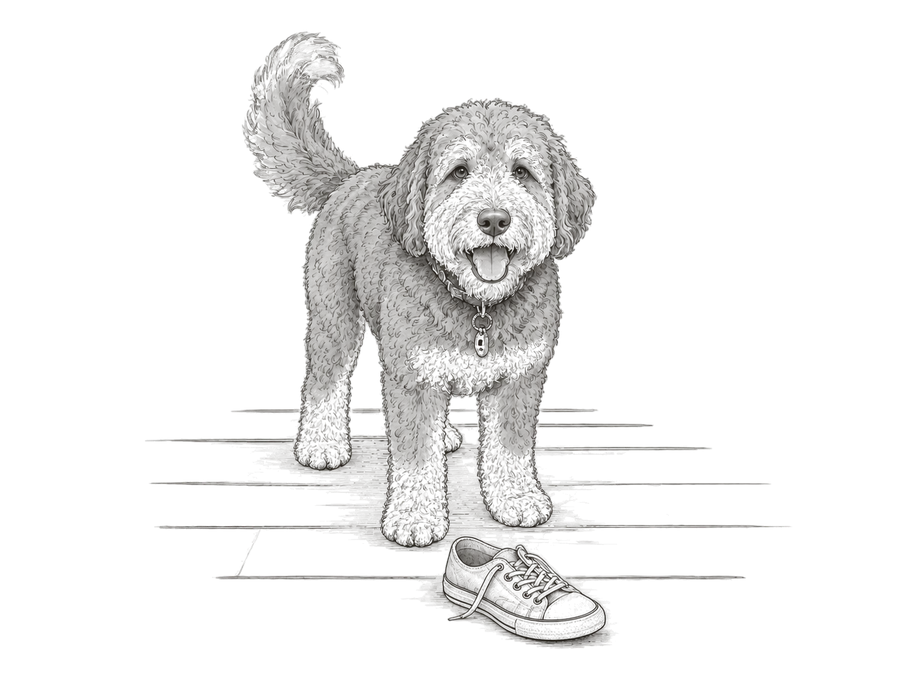
Murphy has now brought Scott a shoe. One shoe. Not a pair. Not the correct shoe for any planned activity. Just: a shoe. An offering. A thesis statement.
Here. I brought you this. I don’t know why. Let’s go.
Scott takes the shoe. Puts it on. Goes to find the other one.
The manuscript will be there tomorrow. The emails will be there in an hour. The bonsai are fine — Parlance is probably judging him from her corner but she’s always judging him from her corner and she’ll still be judging him tomorrow and the day after that.
Right now, there’s a shoe and a dog and late-afternoon Honolulu light coming through the windows, and a house full of people who ranked him last but kept him anyway.
Eighty-seven minutes was too long. Not because of the emails. Not because of the productivity. Eighty-seven minutes was too long because it wasn’t rest. It was retreat. And the difference between rest and retreat is the difference between Murphy’s nap and Scott’s nap — one of them wakes up in the next moment, and the other wakes up checking how much of the day he lost.
Murphy doesn’t lose days. Murphy doesn’t lose minutes. Murphy wakes up and the day is there and he is in it and the distance is zero. Always zero.
Murphy knew. Murphy always knows.
Not because he’s wise. Not because dogs have some mystical connection to human emotional states, although Abby might — Abby reads a room like a clinical psychologist with fur.
Murphy knew because Murphy doesn’t think about why. Murphy just thinks: you’re still in bed. I want you not in bed. Problem. Solution. Nose.
And sometimes that’s all the intervention you need. Not a therapist. Not a manuscript about a man who intellectualizes his way through every crisis. Not a twelve-step framework or a nervous system regulation protocol or a self-help book with a sunset on the cover.
Sometimes you just need sixty pounds of idiot who loves you to land on your chest and say:
Get up. I don’t know why. But get up.
I brought you a shoe.
Chapter Four
Dinner Is at Five
Dinner in the Cooley household is at six o’clock.
This is the official time. It’s the time Ai announces. It’s the time Grandma begins plating. It’s the time Scott has programmed into his internal clock after years of marriage, two children, and the general understanding that when someone spends three hours preparing a meal, you show up when they tell you to show up.
The problem is that dinner is a liar.
Dinner says six. Dinner means 5:52. Or 5:54. Or 5:57 on a generous night. Dinner is a moving target that everyone in the household understands is a moving target except Scott, who continues to believe in the published schedule like a man who still thinks his flight is departing on time because that’s what the board said at the gate, even though the board was written by the same species that invented “we’ll be boarding shortly.”
Murphy understands this.
Murphy has never once in his life consulted a clock, because Murphy doesn’t know what a clock is. Murphy doesn’t operate on scheduled time. Murphy operates on kitchen time — the concatenation of sounds and smells that indicate food is transitioning from preparation to presentation. The cutting board goes quiet. The stove clicks off. A cabinet opens. A plate touches the counter.
These are Murphy’s cues. Not six o’clock. Not an announcement. Not the arbitrary agreement between adults that a certain number on a digital display means something. Murphy runs on a system far older and more reliable than any of that. Murphy runs on thermodynamics: when heat transfers from stove to plate, dinner exists, and when dinner exists, Murphy should be at the table.
He is always at the table.
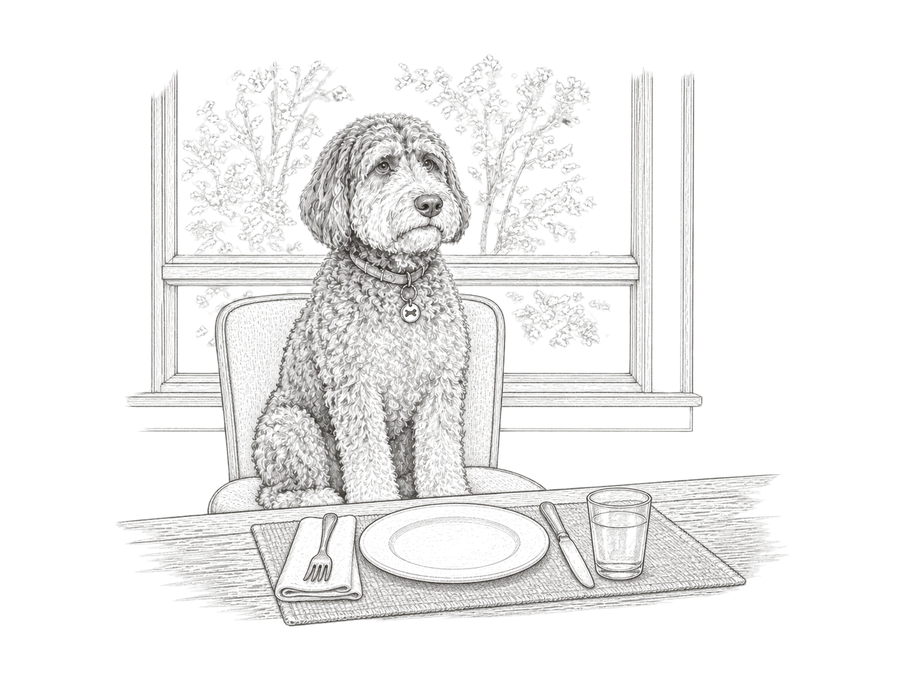
The dining room table seats six. It is a piece of furniture purchased for the purpose of family meals, homework, the occasional board game, and — in Grandma’s months — watercolor painting. It was not purchased for the purpose of serving as a labradoodle’s daytime sleeping platform, but Murphy did not receive this memo, or received it and ate it, which is equally plausible.
During the day, Murphy sleeps on this table.
Not under it. Not beside it. Not in one of the chairs, which would at least maintain the pretense that he understands the social contract between furniture and species. On it. Four legs folded, sixty pounds of brown and white labradoodle in the exact center of the dining surface, positioned with a sightline to every entrance, the kitchen, and the living room. It is, objectively, the most strategically advantageous position in the house. Murphy discovered this not through analysis but through the same process by which he discovers everything: he tried it, nobody stopped him, and so it became law.
Sometimes Grandma is at this table when Murphy is on it. She’ll be painting — watercolors, always watercolors, patient deliberate strokes of color laid down with the unhurried confidence of a woman who has never once set a deadline for art. Murphy will be three feet away, prone, watching her with the quiet attention of a courtier attending his queen. He doesn’t beg. He doesn’t nudge. He holds court. He is available, in case she needs anything, which she doesn’t, which doesn’t matter, because availability is the point.
Grandma ignores him. She has elevated ignoring things to a lifestyle — noise, chaos, the twins’ phones, Scott’s opinions about how the dishwasher should be loaded. She sits, she paints, she feeds Abby from the table when she thinks nobody is looking. Murphy is beside her and she doesn’t acknowledge him and he doesn’t require acknowledgment and this is the most Tuesday Person relationship in the entire household: two beings, occupying the same space, expecting nothing from each other, completely content.
She would never admit she loves it.
Of course she loves it.
At 5:48 on a Wednesday, Grandma begins plating.
This is twelve minutes before the scheduled dinner time, which means it’s approximately seven minutes before the actual dinner time, which means Murphy has roughly four minutes before the window opens and approximately ninety seconds of competitive advantage over Scott, who is in his office finishing an email that he believes is urgent and that no one will read until tomorrow.
Scott doesn’t know it’s 5:48. Scott knows dinner is at six.
Murphy knows what a cabinet sounds like when it opens.
The system, as designed by the children, is elegant.
At some point — Scott doesn’t remember exactly when, which tells you something about how gradually the household adapted to Murphy’s sovereignty — the twins developed a protocol. When dinner is approaching, a child is posted at the table to guard the food. This is the official mandate. The understood purpose is to prevent Murphy from accessing any plate, any serving dish, any unattended morsel.
The execution, however, reveals a more nuanced interpretation.
Carina or Emily — whichever twin drew the short straw or lost the unspoken negotiation that happens between thirteen-year-olds through a series of glances Scott cannot decode — will sit at the table and guard their plate. Their water glass. Their napkin. They will monitor Murphy with the vigilance of a Secret Service agent whose protectee is a single serving of Grandma’s chicken.
Scott’s plate sits unguarded.
This is not an oversight. This is policy. The policy, though never formally articulated, is: guard your food, and fuck Daddy.
On a good night, someone remembers to pull Scott’s chair away from the table.
This is the countermeasure. Murphy, for all his operational brilliance, has not yet solved the engineering problem of mounting a chair that has been pushed several feet from the table. His vertical leap is adequate for couch-to-table transitions, but the chair is a different puzzle — it requires precision, coordination, and a spatial awareness that Murphy applies selectively, mostly to food-related challenges, and the gap between the pulled-out chair and the table exceeds his current capabilities.
On a good night, the chair is pulled out, and Murphy orbits the table like a satellite that has lost its docking port, and Scott arrives at 6:01 to find his seat available and his dinner intact and feels, briefly, like the head of a household that respects him.
On a bad night, someone forgets.
5:53. Wednesday.
Scott is finishing the email. He’s added a paragraph that didn’t need adding and is now editing that paragraph, which is the professional equivalent of Murphy eating an earplug — an action whose consequences are predictable and preventable and yet somehow keep happening.
In the kitchen, Grandma has plated five servings. Tonight it’s beef — a dish that took two and a half hours and will be consumed in fifteen minutes, a ratio that Grandma never comments on because Grandma doesn’t comment on things, she just observes them with the serene detachment of a woman who has been cooking for families long enough to understand that meals are not eaten, they are processed, and the processing time is not her problem.
Ai calls down the hallway. “Dinner!”
This means dinner is ready.
It does not mean six o’clock.
Murphy is in the chair.
Not on the table. The table is for sleeping. The chair is for dinner. Murphy understands the distinction between these two uses of the same piece of furniture with a clarity he does not apply to literally anything else in his life.
He is in Scott’s chair.
Not Carina’s chair. Not Emily’s chair. Not the chair nearest the kitchen, which would be tactically superior for food interception. Scott’s chair. The one at the end. The head of the table. The seat that, in a different household, might signify authority. Leadership. The person who paid for the food and the power and the roof.
Murphy sits in it like a person.
All four feet on the seat. Torso upright. Head above the table line. He is not crouching or hiding or sneaking. He is sitting at the table the way the CEO of a company would sit at the table, except the CEO of this company is still in his office adding a second unnecessary paragraph to an email about server migration timelines, and Murphy is here, and the food is here, and possession is nine-tenths of the law.
Tonight, nobody pulled the chair out.
Emily is in her seat, guarding her plate. Carina is in her seat, guarding hers. Ai is bringing the last dish from the kitchen. Grandma is settling in at her spot, where Abby has already assumed position — not on the chair, not on the table, just there, beside Grandma’s right hand, because Abby knows what Grandma’s right hand does when it’s near the table. Things fall from it. Pieces of beef, fragments of rice, the occasional piece of broccoli that Abby doesn’t want but accepts because you don’t reject an offering from your number two. Or rather, Grandma is Abby’s number two, but Abby is also Grandma’s number one, and the mutual arrangement works precisely because neither of them acknowledges it out loud.
Nothing falls accidentally off that woman’s hand. Nothing has ever fallen accidentally. Grandma feeds Abby from the table with the practiced discretion of a spy passing microfilm, and everyone knows, and no one says anything, because the hierarchy is the hierarchy.
Murphy, meanwhile, waits.
This is the part that kills Scott. Murphy waits. He doesn’t lunge for the food the moment he’s in the chair. He doesn’t bury his face in the plate. He sits there — upright, alert, brown eyes tracking every dish — and he waits for other people to start eating first.
He has decorum.
Not a lot. Not enough to, say, stay off the chair in the first place, or refrain from eating the CEO’s dinner, or stop consuming foam objects he will regret twelve hours later. But enough. Enough to wait for the first fork to be lifted before he makes his move. Enough to understand that there is a sequence to this, a ritual, and his role in the ritual is to wait for the opening and then exploit it with maximum efficiency.
He is not a savage.
He just has a different understanding of whose dinner it is.
5:56. Scott hits send.
He stands up. He does the thing men do when they leave their offices at the end of a task — the stretch, the phone check, the brief accounting of whether anything else is on fire. Nothing is on fire. Everything is fine. Dinner is at six and it is 5:56 and he is early, technically, by the published schedule, and he will arrive at the table with four minutes to spare.
He walks down the hallway. He can hear the sounds of a family eating. Forks on plates. Glasses. A chair scraping. The low murmur of Ai asking someone about homework.
These are sounds that should register as wrong. Family eating sounds at 5:56, four minutes before dinner, should trigger an alert. But Scott’s brain is still in the email, still in the server migration, still in the land of problems that have solutions, and he doesn’t process what he’s hearing until he rounds the corner into the dining room and sees Murphy in his chair, sitting upright, looking at Scott with an expression that is not guilt.
Murphy doesn’t do guilt. Guilt requires a theory of wrongdoing, and Murphy doesn’t have one. Murphy has a theory of opportunity: food was here, chair was here, you were not here, I am here, therefore dinner is mine. The logic is airtight. The logic has always been airtight. Scott has never successfully argued against it because there is no argument against a creature who does not recognize the concept of “your seat.”
“Murphy is eating daddy’s dinner,” someone announces. Emily. Not with alarm. With the tone of a weather report. Currently 78 degrees. Partly cloudy. Murphy is eating daddy’s dinner.
The family looks at Scott. The family does not look at Murphy. The family’s position, refined over two years of cohabitation with this animal, is that Murphy’s presence in the chair is a natural consequence of Scott’s absence from it, and if Scott wanted his dinner, he should have been here at 5:52 when dinner actually started, regardless of what time dinner was theoretically scheduled.
The logic is airtight.
Scott hates that the logic is airtight.
Murphy has eaten the beef.
Not all of it. Enough of it. Enough that what remains on the plate is not a dinner but an archaeological site — evidence of what was once here, a forensic record of how quickly a labradoodle can dismantle a meal that took two and a half hours to prepare.
Murphy dismounts the chair with the unhurried ease of a king leaving his throne. He does not rush. He does not slink. He picks up the napkin — Scott’s napkin, cloth, part of a set Ai bought at a store Scott has never been to — and carries it to the living room.
This is the victory lap.
In the living room, away from the table but within sightline of the family, Murphy settles onto the floor with the napkin between his front paws. He does not eat it. Not immediately. First he holds it. Regards it. A hunter with his trophy.
Then he begins.
The shredding is methodical. Not frenzied, not desperate. Deliberate. A corner first. Then a strip along one edge. He pulls the threads apart with the same patient, systematic approach he applies to Emily’s stuffed animals — one eyeball this week, the tail next week, the stuffing slowly emerging over the course of days like the world’s worst autopsy.
Scott makes himself a sandwich.
Here is what Murphy knows about dinner:
Dinner happens. Dinner happens at a time determined not by clocks but by the readiness of food. When food is ready, dinner begins. When dinner begins, a seat should be occupied. If a seat is not occupied, the seat is available. If a seat is available and food is on the table, the food belongs to whoever occupies the seat.
This is not complicated.
Here is what Scott knows about dinner:
Dinner is at six. He should be at the table at six. He is sometimes at the table at six. When he is at the table at six, dinner started at 5:52 and Murphy is already in his chair. When he tries to be at the table at 5:50, dinner started at 5:47 and Murphy is already in his chair. The system is rigged. The system has always been rigged. The system is rigged because Scott keeps trying to solve it with information — better timing, earlier arrival, predictive modeling of Grandma’s plating patterns — when the problem has never been informational.
The problem is that Scott thinks dinner is about scheduling.
Murphy knows dinner is about showing up.
There’s a thing Scott does — has always done — where he believes that understanding a system means controlling it. At Indevtech, this works. You analyze the workflow, identify the bottleneck, implement the fix. Linear. Logical. The spreadsheet doesn’t move the deadline while you’re solving for the deadline.
But Murphy isn’t a spreadsheet. Murphy is a living being who responds to stimuli in real time, and “real time” does not care about Scott’s calendar, Scott’s email, Scott’s one-more-paragraph-that-didn’t-need-adding. Real time is the sound of the cabinet and the smell of the beef and the availability of the chair, and Murphy lives in real time the way fish live in water — not as a choice, not as a practice, but as the only medium that exists.
Scott lives in projected time. He’s always in the next thing. The email that needs sending. The chapter that needs revising. The conversation he’ll have tomorrow. He arrives at dinner at the time dinner was supposed to be because he planned for the time dinner was supposed to be, and by the time he gets there, the present has already moved on without him.
And every night, Murphy gets to the table first. Murphy is already there. Murphy is always already where the thing is happening, because Murphy doesn’t live anywhere else.
Dinner is not at five. Or 5:52. Or six.
Dinner is at now.
And Murphy is the only one in the household who knows what time that is.
At 6:14, the table is cleared. Fifteen minutes. Two and a half hours of preparation, fifteen minutes of consumption, and one labradoodle’s worth of theft. Grandma is already washing dishes. She does not use the dishwasher in the way Scott believes the dishwasher should be used, and Scott has learned not to raise this issue, which is one of the few areas where he has successfully applied the principle of knowing when not to show up.
Abby has retreated to the white sofa. She ate well — Grandma’s hand is generous, and the things that fall from it are always the best pieces, because Grandma loves Abby the way Grandma loves everything: without announcement, without condition, with absolute reliability.
Murphy is asleep on the dining room table.
Not the chair. The table. Dinner is over. The table has reverted from its dining function to its other function: Murphy’s bed. He is in the center, in his spot, with a sightline to every entrance, satisfied in the way only a creature with no regrets can be satisfied.
He got the beef. He got the napkin. He got the chair.
Scott got a sandwich.
Grandma finishes the dishes. She dries her hands on a towel — not the towel Scott would choose, but he’s learned — and walks past the dining room table. Murphy is asleep. She pauses. Doesn’t touch him. Doesn’t say anything.
But her hand drifts, just slightly, toward the table. Hovers over his head. Doesn’t land.
She walks on.
Of course she loves it.
Chapter Five
The Walk Is Not a Metaphor
Every dog owner will tell you that the walk is important.
They’ll say it with the earnestness of people who have read articles about it, or talked to a vet about it, or watched a show where a calm man with good posture explained that walking your dog is about energy and leadership and being the alpha or the omega or whatever Greek letter is trending this decade. The walk is exercise. The walk is stimulation. The walk is bonding. The walk is a cornerstone of responsible pet ownership.
None of this is wrong.
But it’s like saying that dinner is about nutrition. Technically correct. Completely beside the point.
The first walk of the day leaves the house at 7:05.
This is not when the walk begins. The walk begins at 6:50, when the car starts, because in the Cooley household, the morning walk is a logistical operation that requires a vehicle, six passengers, a specific seating arrangement, and the quiet resignation of a man who is not involved but whose salary paid for all of it.
The formation is as follows: Murphy rides shotgun.
Not in the back seat. Not in the cargo area. Shotgun. Front passenger seat. Upright, facing forward, with the posture and apparent seriousness of a copilot monitoring airspeed. He does not look out the side window. He does not lie down. He watches the road ahead with the focus of a creature who believes his vigilance is the only thing preventing catastrophe, and nobody has told him otherwise, because nobody wants to be responsible for what Murphy does if he’s not given a job.
Abby is in the way back. This is not a demotion. This is preference. Abby selected the way back the same way she selects everything — once, definitively, without discussion. The way back is quieter. The way back has no Murphy. The way back is the Tuesday Person section of the vehicle.
Grandma sits with Abby, or near her, or in whatever configuration allows Grandma to exist in the car without acknowledging that the morning routine is slightly insane. The twins are in the middle row, existing in the parallel dimension of thirteen-year-olds who are technically present but whose consciousness has already departed for school, for phones, for whatever interior world teenagers build to survive mornings.
Ai drives.
Scott is not in the car. Scott’s involvement in the morning walk is the same as his involvement in most household operations: financial. He pays for the car. He pays for the gas. He pays for the dog food that fuels the bodies that require the walk. He is the invisible infrastructure. He is the municipal water system of this family — essential, unacknowledged, and expected to function without thanks.
The twins are dropped at school. The car continues to wherever Ai and Grandma go, which is the place where the walk happens, and Scott has never fully mapped their routes because the routes are not his business. The walks belong to Ai and Grandma the way the white sofa belongs to Abby — through long use, quiet authority, and the understanding that some things are not up for discussion.
Here is how Ai and Grandma walk the dogs:
They walk.
That’s it. That is the entire methodology. They walk and the dogs walk and sometimes Ai and Grandma talk to each other and sometimes they don’t and the dogs don’t care which because the dogs are not listening to the conversation. The dogs are smelling things. The dogs are investigating a patch of grass that, to a human, is a patch of grass, but to a dog is a newspaper — headlines, editorials, opinion pieces, a detailed account of which animals passed through and when and what they’d eaten and how they felt about it.
Grandma stops to smell flowers.
Not metaphorically. Not as a life practice or a mindfulness exercise or a thing she read about in a magazine about living your best life. Grandma smells flowers because flowers smell good and she is near them and her nose works. She bends down — or doesn’t, if the flowers are tall enough — and she smells them, and then she takes a photograph with her phone, not to post anywhere, not to show anyone in the moment, but to look at later, at the dining room table, while Murphy holds court beside her and she paints what she saw.
She is collecting the walk to revisit it.
Grandma is not just in the moment. She’s archiving it. Not because the moment is fleeting and she’s anxious about losing it — that’s the Instagram version, the desperate grab at experience as it passes. Grandma photographs flowers because she knows the moment is sufficient now AND later. The flower is beautiful on the sidewalk. It will be beautiful again on the watercolor paper. Nothing is lost. Nothing needs to be captured. She’s just... continuing the conversation with it.
Murphy does not smell the flowers. Murphy smells everything else. Murphy smells the base of every mailbox post and fire hydrant and tree trunk with the forensic intensity of a detective at a crime scene, except the crime is another dog existing, and Murphy finds this thrilling every single time, as if the concept of other dogs never stops being breaking news.
Abby walks at Grandma’s pace. Abby has selected Grandma’s pace because Grandma’s pace is the correct pace — unhurried, consistent, punctuated by occasional stops that Abby tolerates with the patience of a creature who learned long ago that humans are slow and distractible and you just have to wait them out.
Nobody is on the phone.
Nobody is talking to someone who isn’t there.
Nobody is anywhere other than where they are.
The dogs know this. You might think dogs can’t tell the difference — that a walk is a walk is a walk, that as long as the leash is moving and the route is happening, the human on the other end is interchangeable. You would be wrong. Dogs read the leash the way a sailor reads a rope. Tension, slack, rhythm, the micro-adjustments that telegraph whether the person holding it is here or elsewhere. Ai and Grandma are here. The leash knows. The dogs know.
This is the walk against which all other walks are measured.
Here is how Emily walks the dogs:
Emily is thirteen. Emily walks the dogs after school because walking the dogs after school earns money, and money is important when you’re thirteen and your father has explained, with the weary patience of a man who has replaced four pairs, that he will not purchase another set of AirPods until you demonstrate the ability to not lose them in the abyss between your locker and the pickup line.
So Emily has wired earbuds.
Wired. With a cord. Connected physically to her phone like some kind of medieval communication device. She puts them in and plays music — Scott doesn’t know what music, because asking a thirteen-year-old what music they listen to is an invitation to feel old in a way that serves no one — and she walks the dogs on the hill.
The hill. The hill that everyone in the Cooley household must contend with because someone, at some point, decided to build a house on it. Emily hates the hill. She has expressed this. She expresses most things. She does not have Grandma’s serene acceptance or Ai’s quiet competence about the hill. She has the energy of a teenager who would prefer flat ground and a car and is annoyed at the universe for providing neither.
But she walks the hill. With the dogs. With her wired earbuds playing music the dogs can’t hear.
And here’s the thing:
The dogs think she’s present.
The dogs cannot hear the music. The cord runs from her ears to her pocket, invisible to a creature whose sensory hierarchy starts with nose and ends somewhere around “abstract visual pattern recognition.” Murphy doesn’t know Emily is listening to something. Murphy knows Emily is here, walking, holding the leash, occasionally saying his name when he lunges at a bird. Abby doesn’t know Emily is somewhere else. Abby knows Emily is at the other end of the leash, moving at an acceptable pace, available.
Emily is the most accidentally present person in the household.
She’s not trying to be present. She hasn’t read about it. She doesn’t have a practice or a philosophy or a morning protocol. She’s just a thirteen-year-old walking two dogs on a hill she hates with music in her ears and no particular intention beyond earning enough money to eventually buy AirPods that she will, statistically, also lose.
But from the dogs’ perspective? Emily is right there. Right here. Every time.
The dogs don’t need you to be spiritually present. They need you to be here. Physically. Holding the leash. In the same space at the same time, moving in the same direction.
Emily clears that bar every single time, and she’s not even trying, and she’s listening to music, and she hates the hill.
The dogs don’t know she hates the hill. The dogs think the hill is incredible. The hill has smells. The hill has birds. The hill has that one spot where something died three weeks ago and Murphy checks every single walk to see if it’s still there and it always is and he’s always thrilled.
Emily walks them and collects her money and goes to her room and the dogs think they just had the second-best walk of the day. Because they did. Because she was there. That’s all it took.
Emily also has more homework than any human being should be expected to complete. She also has badminton. And friends. And Roblox, and Minecraft, and YouTube videos of other people playing Roblox and Minecraft, which is the part that would break a time-management consultant: hours watching strangers do the thing she could be doing herself, in the game she already owns, on the computer she’s already sitting at. It’s like watching someone else eat your dinner.
And yet. Nobody knows when the homework gets done.
It’s like a pay phone — nobody has ever seen someone take the quarters out, but you know they must, because otherwise it’d be overflowing. Emily’s homework exists in a similar quantum state. It is never observed being completed. There is no “homework hour.” There is no visible transition from Roblox to pre-algebra. The homework simply gets done. Acceptable grades appear on the report card. The system works.
Adults with half her workload and twice her free time accomplish less. Scott, with an entire open calendar and a club membership and a laptop bag optimized for poolside productivity, cannot account for his hours the way Emily fails to account for hers. She doesn’t manage time. She ignores it entirely. And it works the way Murphy works — without a plan, without a schedule, without the organizing principle of guilt.
Here is how Scott walks the dogs:
Scott puts the dogs in the car.
Let that sit for a moment. Absorb it. The man lives on a hill. The hill has sidewalks. The hill has air and trees and Hawaiian light that tourists pay thousands of dollars to stand in for a week. The hill has, presumably, smells that Murphy would find as riveting as any smell on any other surface on the planet, because Murphy has never ranked a smell in his life. Every smell is the best smell.
Scott puts the dogs in the car and drives them down the hill to the flatlands.
Because he doesn’t like walking on the hill.
He doesn’t like the incline. Or the effort. Or the particular cardiovascular challenge of walking uphill in this part of East Honolulu, which is not Everest, which is not even notably steep by any objective standard, but which is steep enough that Scott has decided it’s not for him, and rather than simply walking the hill he lives on, he loads two dogs into a vehicle, drives to a flatter part of the neighborhood, and walks there.
Murphy loves the car ride. Murphy loves everything. Murphy would love a ride to the veterinarian who is about to stick a thermometer in his ass because Murphy does not connect current transportation with future consequences. Murphy in the front seat, watching the road, copilot to a man who is avoiding a hill — this is peak Murphy experience. New smells! Movement! Going somewhere! The details are irrelevant!
Abby gets in the car because Abby gets in the car. She doesn’t need a reason. She doesn’t need enthusiasm. She needs the door to be open and the expectation to be established and she will comply with the quiet competence of a middle manager who doesn’t love the initiative but has decided to support it for institutional reasons.
They arrive at the flatlands. Scott parks. Scott puts in both AirPods.
Both. Not one ear casual, one ear available for the world. Full stereo. Complete seal. And then he does something that, if you described it to a time-management consultant, would sound like the behavior of a very busy man, but if you described it to Grandma, she would say nothing, which is how Grandma says everything.
He calls someone.
Not someone important. Not a client. Not a business emergency. Scott calls whoever is available. He has, in fact, already figured this out before leaving the house. This is not a spontaneous dial. This is scheduled programming. Scott has surveyed his mental roster of friends, colleagues, and people-he-hasn’t-caught-up-with-in-a-while, identified who is likely to be in their car driving home or between obligations during the specific window of 4:15 to 5:00, and timed his departure to coincide with their availability.
He has done more planning for this phone call than Murphy has done for any event in his entire life, including meals.
The call is never important. This is the key. The call is the least important conversation of Scott’s day. It’s a catch-up. A check-in. A “hey, haven’t talked in a while, how’s everything” that fills the air for forty-five minutes and requires nothing and produces nothing and exists for the sole purpose of ensuring that Scott’s ears are occupied while his feet are moving.
He is not multitasking. He is manufacturing noise.
The effort required to avoid silence exceeds the discomfort of the silence itself. Scott knows this. Scott finds it funny in the way you find things funny when you’ve identified a pattern in yourself and chosen to keep doing it anyway, which is — if you’re keeping score — the exact same thing Alex does for 311,895 words in a manuscript sitting on a hard drive in Scott’s office.
The dogs walk beside him. Murphy is exploding with joy because he’s outside and the ground has smells and the air has birds and there’s a thing over there that might be a cat but might be a bag but either way he needs to investigate immediately. Abby is walking at her pace, which is Abby’s pace, which does not adjust for the human on the leash.
Scott is not here.
Scott’s body is here. Scott’s hand is on the leash. Scott’s feet are on the flatlands that he drove to because the hill was too much. But Scott — the actual Scott, the consciousness, the person — is in the AirPods. He’s in the conversation. He’s in next week. He’s in the email he should have sent. He’s in the manuscript chapter that isn’t working. He’s anywhere but on this walk, on this street, with these dogs, in this air.
Murphy can feel the leash.
The leash when Scott is on the phone is different from the leash when Scott is not on the phone. When Scott is on the phone, the leash is an afterthought — a tether managed by motor memory, corrections coming a half-second late because the attention is elsewhere. The leash tightens when Murphy finds something interesting because Scott hasn’t noticed Murphy stopping. The leash goes slack when Scott walks ahead because Scott has forgotten the pace isn’t his to set. The leash is a seismograph of distraction, and every vibration says: I’m holding you but I’m not with you.
Murphy doesn’t mind. Murphy doesn’t hold grudges or keep accounts. Murphy is having a walk and a walk is a walk and even a walk with an absent human is better than no walk, the same way Emily’s walk with wired earbuds is still a walk, the same way a sandwich is still dinner when your labradoodle has eaten your beef.
But there’s a difference.
When Ai and Grandma walk the dogs, the dogs come home settled. Something in them — something behind the panting and the water-bowl sprint and the collapse onto the cool tile — is quieter. Regulated. As if the walk didn’t just tire their bodies but organized something in their nervous systems, the way a deep breath organizes something in yours. They were with people who were with them, and the circuit completed, and the energy that went out through the leash came back through the leash, and the system balanced.
When Scott walks the dogs, they come home exercised.
Not settled. Exercised. Their bodies are tired but the energy is still jangling, still looking for somewhere to land, because the circuit never completed. Scott was on the phone. The energy went out through the leash and hit a busy signal.
Murphy doesn’t know why some walks feel different from other walks. Murphy has never thought about the quality of attention or the difference between physical proximity and emotional presence. Murphy just knows that after some walks he lies down on the dining room table and sleeps like the dead, and after other walks he lies down on the dining room table and then gets up and tries to mount his sister and then steals a stuffed animal and removes its eyeball.
Abby knows.
Abby has always known. Abby reads the leash and the pace and the posture and she files the information away in whatever database she maintains behind those brown eyes, and she doesn’t judge — Abby reserves judgment for sofa disputes and hierarchy enforcement — but she knows. She knows the difference between a walk with Grandma and a walk with Scott the same way she knows the difference between the sound of Ai’s car and the sound of the neighbor’s car. It’s not intellectual. It’s not analytical. It’s just: this is this and that is that.
She walks with Scott anyway. She always will. He’s number three in the hierarchy but he’s still in the hierarchy, and the hierarchy means something to Abby. It means: you are mine and I am yours and we walk together even when you’re on the phone, even when you drove us down the hill because you didn’t want to walk the hill, even when the leash says you’re somewhere else.
She just knows it’s not the same.
There’s a version of this that Scott hasn’t tried.
The version where he walks out the front door. Up the hill. The hill he lives on. The hill he’s lived on his whole life. Without the car. Without the AirPods. Without the conversation with someone who isn’t here about something that isn’t happening.
Just: the hill and the leash and the dogs and the air.
Just: Murphy exploding because outside exists. Abby walking at her pace. The smell of plumeria that Scott has never noticed because he was on the phone when he passed it.
Just: being the third-best person in his own household, walking up a hill he doesn’t like, with two dogs who don’t care about the incline or the effort or the cardiovascular challenge. Murphy doesn’t know the hill is steep. Murphy knows the hill has smells. Abby doesn’t have an opinion about the hill. Abby has an opinion about the pace, and the pace should be hers, and if you’re going to be here then be here.
Scott hasn’t tried this version.
He hasn’t tried it because quiet is loud.
A walk without input — without the podcast, the call, the music, the narration — is a walk with nothing between you and the inside of your own head. And the inside of Scott’s head is a busy place. The manuscript lives there. The business lives there. The to-do list and the bonsai guilt and the memory of every email he hasn’t answered and every chapter he hasn’t revised and every conversation he’s been meaning to have but keeps scheduling for next week. The AirPods aren’t entertainment. The AirPods are insulation. They’re the buffer between Scott and the silence that happens when you stop talking and start walking and the only sounds are your feet and the leash and a labradoodle losing his mind over a mailbox.
That silence has things to say. Scott isn’t ready to hear them.
You can’t put “walk without AirPods” on a calendar and expect it to transform you. You can’t optimize your way into presence. Being here isn’t about the terrain. It’s about the leash. It’s about what travels through it. It’s about whether the signal you’re sending down that nylon cord is I’m here with you or I’m here but I’m also somewhere else and the somewhere else is winning.
Somewhere on a flatland street in East Honolulu, Scott is on the phone. The call is unimportant but necessary — necessary in the way Scott has redefined necessary, which is: it fills the air and that’s enough. The dogs are at the end of the leash, walking, doing what dogs do, and Scott is doing what Scott does, which is being in two places at once and fully in neither.
Murphy finds something extraordinary at the base of a speed limit sign. He stops. The leash tightens. Scott keeps walking for two steps before the tension registers, and then he stops, and for a moment — just a moment, between one sentence and the next in whatever conversation he’s having — he looks down at Murphy.
Murphy is smelling the speed limit sign with the intensity of a sommelier evaluating a rare vintage. His entire body is committed to this smell. His nose, his posture, the slight tremor in his tail that indicates not excitement but concentration. This smell is important. This smell is happening right now. This smell requires Murphy’s complete and undivided attention.
Scott watches this for three seconds. Maybe four.
Then the person on the phone says something and Scott says something back and the leash goes slack and they’re walking again and the moment passes. It was never a moment to Murphy. It was just: now. And then the next now.
The walk continues. The call continues. The hill waits at home, unwalked.
Thursday. Different walk. Same flatlands. Same AirPods. Same roster-check before departure — who’s driving home between 4 and 5, who hasn’t heard from me in a while, who’ll pick up?
Scott is mid-sentence about nothing — something about a restaurant someone went to, or a show someone watched, the kind of conversation that exists to exist — when Murphy stops.
Not at the speed limit sign this time. Something else. Something in the grass near the curb. Something that, based on Murphy’s full-body commitment to investigating it, is either profoundly important or profoundly disgusting. With Murphy these categories overlap more than any dog owner is comfortable admitting.
Scott stops. The leash is taut. The person on the phone is talking. Murphy is not moving.
And Scott’s eyes, with nowhere else to go for a moment — phone in one hand, leash in the other, feet stopped, conversation on autopilot — drift.
Not far. Not intentionally. His eyes just... land.
There’s a plumeria on the sidewalk.
Not a remarkable one. Not a photograph-worthy one, not by any standard Scott would apply, which is the standard of a man who evaluates most things by whether they’re worth the time, and a flower on a sidewalk is not worth the time, and he’s on the phone, and Murphy is doing something unspeakable in the grass, and there’s no reason to notice this.
He notices it.
It’s white with a yellow center, which is what plumerias look like, which Scott knows because he lives in Hawaii and plumerias are everywhere and he’s not an idiot. But knowing what a plumeria looks like and seeing one on the sidewalk while your dog investigates something awful and your friend is telling you about a restaurant are different things. One is information. The other is — he doesn’t have a word for it. It’s not a revelation. It’s not a moment. It’s smaller than that. It’s just his eyes on a flower for two seconds because Murphy stopped and Scott had nowhere else to look.
He doesn’t photograph it. He doesn’t bend down. He doesn’t interrupt the call to say “hey, there’s a flower here.” He doesn’t do anything at all.
Murphy finishes his investigation. The leash goes slack. Scott walks.
“Sorry, what were you saying?” he says into the phone, which is what you say when you’ve missed a sentence, which he has, because for two seconds he was looking at a plumeria instead of listening to a man describe Brazilian steak.
The walk continues. The call continues. Scott does not think about the flower again.
But he saw it.
He doesn’t know that Grandma sees it every week. He doesn’t know she photographs it, or that it appears in her watercolors, or that the dining room table where Murphy sleeps has held three different paintings of this same tree’s blossoms. He doesn’t know that the flower has been waiting for him on this sidewalk for a hundred walks, patiently, the way Abby waits for him to come home, the way Murphy waits for someone to start eating before he steals their dinner.
He doesn’t know any of this. He just saw a flower. While on the phone. While avoiding the hill. While manufacturing noise to fill the silence. While doing everything exactly the same as he always does.
But he saw it.
It’s not enough. It’s not the walk without AirPods or the hill with the dogs or the silence he’s been avoiding since — well, since longer than he’d want to calculate. It’s not Grandma bending down with her camera. It’s not Emily accidentally being present on the hill she hates. It’s not Murphy, who sees everything because Murphy is always where he is.
It’s just a man who looked at a flower for two seconds because a dog stopped at the right time.
It’s not enough.
But it’s not nothing.
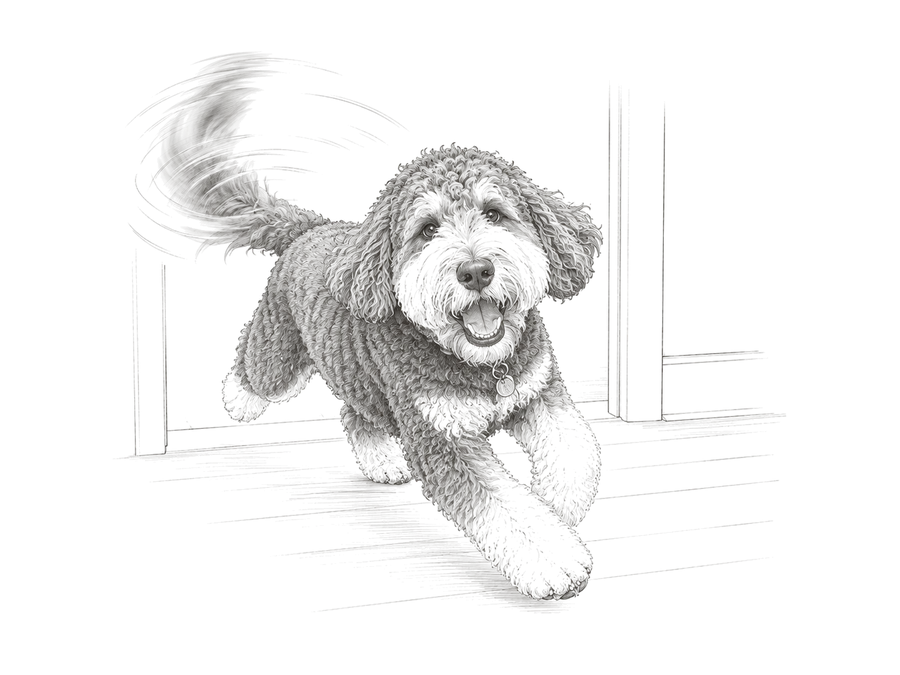
Chapter Six
Why Did You Leave
Scott starts packing three weeks before the trip.
Not mentally. Physically. The suitcases come up from the basement twenty-one days before departure. They open like mouths on the bedroom floor, and Scott begins feeding them. Shorts. Shirts. The sandals he only wears in Japan. The adapter plug. The adapter plug for the other adapter plug. Toiletries in a ziplock bag arranged with the organizational intensity of a man who once ran flight checklists for a living and has never fully accepted that packing for vacation doesn’t require the same rigor as packing for a cross-country in the Piper Twin.
Two weeks before the trip, he’s done. Suitcases full. Zipped. Staged against the wall like soldiers awaiting deployment. He’s ready. Completely, aggressively ready. With fourteen days to go and absolutely nowhere to be.
Murphy is on the dining room table.
Murphy does not know about Japan. Murphy has never heard of Osaka. Murphy has no suitcase, no adapter plug, no opinion about sandals. Murphy knows that the table is flat, the table is his, and that sleeping on it is a complete activity that requires no justification and no follow-up. Murphy has been ready for today since he woke up today, which is the only day Murphy has ever needed to be ready for.
Abby is on the white sofa. She has also not packed. She will also not pack. She’s been on the white sofa for an hour. If you told her the family was leaving for three weeks, she would continue to be on the white sofa, because the white sofa is where she is, and where she is is the only place that exists.
Ai has not packed. Ai will not pack until the morning of the flight. Ai’s packing process is as follows: drag the suitcases up from the basement — no, wait, Scott already did that three weeks ago. Fine. Stage the clothes the night before. Then, on the morning of departure, squeeze everything into the suitcases in the spaces between vacuuming the house, washing all the sheets, and cleaning the kitchen until it’s spotless, because Cousin Bonnie and her friend are housesitting and the house must be immaculate for guests even though it’s just Scott’s cousin and she doesn’t care.
Scott has been packed for two weeks. Ai packs in forty-five minutes between chores.
They will both arrive at the airport at the same time.
The morning of departure.
The flight is at 2 PM. It’s a direct from Honolulu to Osaka. Scott flies Delta One, which means check-in takes two minutes. He has TSA PreCheck, which means security takes three. The math, if you’re keeping score, is as follows: leave the house at 11:30, arrive at the airport by noon, spend five minutes on logistics, then sit in the SkyClub for an hour and fifty-five minutes waiting to board a plane he’s been mentally sitting in for three weeks.
Scott sets his alarm for 6:30 AM.
The flight is at two. He needs to leave at 11:30. His alarm is for 6:30. This gives him five hours to do the following: drink coffee, exist, and leave.
He gets up. He drinks coffee. He drinks it leisurely, because there is genuinely nothing to do. The suitcases have been packed for fourteen days. The house is being cleaned by Ai. The children are either asleep or pretending to be asleep because they’re teenagers and it’s summer and 6:30 AM is a war crime in their jurisdiction.
By 7:30, Scott is anxious. He’s not anxious about anything specific. He’s anxious because he’s awake and dressed and packed and there are four hours until the Uber and his body doesn’t know what to do with time that has no task in it. So he walks the dogs.
He walks them the normal route. The same route they walk every day. Murphy pulls toward every smell. Abby walks at her own pace and does not pull because Abby has never rushed anywhere in six years of life. They do the loop. They come home. It’s 8:30.
Three hours until the Uber.
Scott debates taking a nap. He has time. He has so much time. But if he naps now he won’t be able to sleep on the plane, and the flight to Osaka is ten hours and he should sleep on the plane because they land at 8 PM and then there’s the limo to Kyoto which is another hour and he needs to be functional for that because he’ll want to be present for the arrival at Sayo’s apartment because that’s when the trip really starts.
He is managing his energy for an event that is fourteen hours away. He is pre-optimizing his consciousness like a man budgeting fuel for a transatlantic crossing. He has taken the simple question of “should I nap” and turned it into a strategic calculation involving two time zones, a limo, and the definition of “functional.”
Murphy is asleep on the dining room table.
Abby is asleep on the white sofa.
Neither of them debated it.
Scott does not nap. He kills time. He checks the Delta app. He checks the seat map. He checks the SkyClub hours even though he’s been to this SkyClub forty times and it’s always open. He looks at the clock. It’s 9:15. He looks at the clock. It’s 9:22. He looks at the clock and wonders why he set his alarm for 6:30 when he could have slept until 10 and still had ninety minutes of nothing to do.
The Uber comes at 11:30. Scott has been standing at the curb for three minutes.
Here is what happens at the airport: nothing, for two hours.
Check-in: two minutes. A woman in a Delta One uniform smiles at Scott like he’s a person who matters, which he does, because he paid for the ticket that makes him a person who matters in this specific fifty-foot radius of the Honolulu airport.
Security: three minutes. TSA PreCheck. Shoes stay on. Laptop stays in the bag. Scott walks through the scanner like a man who has solved airport security, which he has, for $85 every five years.
And now: the SkyClub.
Scott gets a drink. He gets a snack. He sits in a chair that is slightly nicer than a regular airport chair and looks out the window at planes that are not his plane. He checks the gate. He checks the time. He has an hour and fifty minutes until boarding.
He is, by any objective measure, waiting. He rushed through the efficient parts — the two-minute check-in, the three-minute security — so that he could get here faster. Here, where there is nothing to do but wait. He optimized his way into a holding pattern. He’s a man in a lounge, in a chair, killing time he manufactured by being early to a process designed to be fast.
The flight boards. Scott is in Group 1 because of course he is. He sits down. The seat is very nice. He has a blanket and a menu and a glass of something and ten hours of sky between here and Osaka.
He waits to take off.
He waits to reach cruising altitude.
He waits to land.
The plane touches down in Osaka at 8 PM local time.
Immigration. Baggage claim. The walk through the arrivals hall. And then: the limo driver, holding a sign. Scott reads it in Japanese because Scott reads Japanese because Scott lived in Kyoto in college and knows the city better than Ai or her sister Sayo or their mother. This is a detail that matters because it eliminates the expected narrative. Scott is not a tourist fumbling through a foreign country. Scott is a man returning to a place he knows by heart. His anxiety about time has nothing to do with unfamiliarity. It has everything to do with being human.
The limo pulls out of the airport. It’s an hour to Kyoto. 8 PM, no traffic. The highway is smooth and dark and the kids are in the back seat and Ai is next to him and the city lights are starting to appear and this — this moment, in the limo, on the highway, an hour from Sayo’s apartment — this is when it becomes real.
Three weeks of packing. Five hours of morning. Two hours of SkyClub. Ten hours of sky. And now, in the back of a limo on a Japanese highway, the trip begins.
Scott can feel it. The expansion. Twenty-one days ahead. Three weeks of Kyoto, a city he carries in his body the way Murphy carries the location of every food source in the house. He knows every temple. Every backstreet. Every coffee shop. He knows where the good ramen is and where the tourists go for bad ramen and which shrines are empty at 7 AM before the heat turns the city into a sauna.
Twenty-one days. The time feels enormous. Limitless, almost.
Almost.
Day one: we just got here. There’s so much time. Look at all this time. The possibilities are expanding in every direction and Scott is standing at the center of all this time like a man who’s been given the ocean and doesn’t know which direction to swim.
Day four: the rhythm is established. Wake up, eat, temple, walk, eat, nap, eat, walk, sleep. It’s good. This is good. Scott is in it. For four days, maybe the only four days, Scott is where his body is.
Day seven: halfway. The word “halfway” arrives in Scott’s mind uninvited and sits there like a countdown timer he didn’t ask for. Fourteen days left. That’s still a lot. But it’s also half of what he started with, and the second half will feel faster than the first half because that’s how time works when you’re watching it, which is always, because Scott is a human and humans watch time the way dogs watch squirrels except the squirrel is your own mortality.
Day ten: the script flips. Scott is no longer counting up from arrival. He’s counting down to departure. He begins to pre-grieve the trip. He is sad about leaving a place he is still in. He misses home while he’s not home. He misses Japan while he’s in Japan. He is somehow homesick in two directions simultaneously, which is a uniquely human achievement that no dog has ever accomplished because no dog has ever been anywhere other than where it currently is.
Day fourteen: Scott starts packing. Again. Mentally first, physically later. He’s doing the whole thing in reverse, and the thing hasn’t ended yet, but he’s already leaving. He left two days before he leaves.
Day seventeen: the heat has killed whatever expansion was left. Kyoto in summer is doing what Kyoto in summer always does: making the outdoors uninhabitable by noon. The apartment becomes the world. Sayo is on the floor with her phone. The twins are on the floor next to Sayo with their phones. Sayo sets a poor example in this regard and the twins do not need encouragement. Scott still gets out. Every day. He sits in air-conditioned cafes and writes comedy on his laptop and drinks iced coffee and watches Kyoto through plate glass. He has flown eleven hours to sit in a coffee shop and type, which is what he does in Honolulu, except the coffee costs ¥700 and there’s a temple across the street he’s already visited nine times across three decades.
Day nineteen: everyone wants to be home already. Nobody says “I want to go home.” What they say is: “Next year, we should leave before it gets so hot.” Or: “Maybe three weeks is too long. Two weeks. Two weeks is the sweet spot.”
There is no sweet spot. Scott knows this because he has this conversation every year and then books the same three weeks the following May. The contraction is not a failure of planning. It’s a feature of being a creature who experiences time as a resource being spent rather than a medium being inhabited.
The limo to Osaka is at 4:30 PM.
The flight is at 9. The airport is an hour away. The math, once again, is a monument to anxiety: four and a half hours of buffer for a sixty-minute ride and an airport process that will, once again, take five minutes.
Scott has learned nothing from the departure.
The alarm. The packing — Ai repacking, because Ai packs on departure mornings the way other people breathe, without apparent effort, while simultaneously cleaning the apartment and thanking Sayo and finding the kids’ chargers and being a functional human. Scott carries the suitcases down. The suitcases he packed, essentially, three weeks and twenty-one days ago. Two timelines of packing, folded on top of each other. The going and the coming back. He’s been packing for six weeks if you count both directions, and he does count both directions, because he is a person and people count.
The limo arrives. They drive to Osaka in the late afternoon sun. The same highway, reversed. The same limo, reversed. The kids in the back seat, reversed.
Osaka. Check-in. Security. The SkyClub, or whatever they call it in Japan. The same chair in a different country. The same drink. The same window. The same waiting.
They board. They fly. Eight hours in the other direction. They land in Honolulu and the air hits them like a warm, familiar hand and Scott thinks: home. And then: how long were we gone? And then: it went fast. And then: it always goes fast. And then: why does it always go fast?
Baggage claim. The Uber. The drive home. The pulling into the driveway. The light on his own street at whatever time it is.
The door opens.
Murphy comes unglued.
Full detonation. Not a tail wag — a full-body event. He’s off the table and at the door before Scott’s second foot crosses the threshold. Front paws on Scott’s chest, face to face, the whine that isn’t sadness but overflow, like the joy has exceeded the capacity of the tail and has to go somewhere so it comes out of his mouth and his whole shaking body.
Abby is behind him. She lets Murphy go first in moments of chaos because Abby has a protocol for everything. She walks up. She presses her head into Scott’s hand. One press. Firm. Deliberate. You’re back. Good. I’m going to the sofa now.
Scott drops to the floor.
Not because his legs give out. Not because it’s a moment. He drops to the floor because Murphy is already climbing on him and it’s easier to be down here and the suitcases can wait and Ai is handling the suitcases anyway because Ai handles everything on arrival mornings the way she handles everything on departure mornings which is completely and without visible stress.
Murphy is on Scott’s chest. Scott is on the floor. The tile is cool and Murphy is warm and heavy and vibrating with the frequency of a labradoodle who has had his person returned to him after the longest absence of his short life.
This greeting is calibrated. Scott has tested this.
When he takes the trash can to the street and comes back three minutes later, he gets a tail wag and maybe a glance. When he comes home from work after ten hours, he gets an enthusiastic hello, some circling, a toy brought to the door. When he comes home from Japan after three weeks with a housesitter running the show, Murphy loses his fucking mind.
The dogs are measuring something. Not time — they don’t have clocks. They’re measuring disruption. How much did the hierarchy shift? How much recalibration was required? The housesitter wasn’t bad. The housesitter was fine. But the housesitter was not the primary person, and the return of the primary person after an extended absence with secondary hierarchy in place — that’s the event. That’s what earns the detonation.
Here is what Murphy’s three weeks looked like:
Scott left. Cousin Bonnie came. Bonnie fed Murphy and walked Murphy and existed in the house with Murphy and Murphy adjusted to Bonnie because Bonnie was here and being here is the only credential Murphy requires. The hierarchy shifted. Bonnie was not Scott but Bonnie was present and presence is the whole interview. Murphy did not pace the house wondering when Scott would return. Murphy did not count days. Murphy does not have a midpoint. Murphy has today. He had today twenty-one times in a row and each one was today.
But now the door is open and the primary person is back and the hierarchy is restoring itself in real time and this is what earns the detonation. Not the duration of the absence. The magnitude of the recalibration.
If Murphy could see the full picture — the three weeks of packing, the alarm clock, the five hours of nothing, the SkyClub, the ten-hour flight, the limo, the expansion week, the plateau, the contraction, the “next year we’ll come earlier,” the reverse limo at 4:30 PM for a 9 PM flight, the reverse airport, the reverse SkyClub, the reverse ten hours, the landing, the Uber, the driveway — if Murphy could see the entire machine of human time management deployed in service of leaving and returning to the same place, he might sit down and tilt his head to one side and think:
Why did you leave?
Not accusatory. Not guilt-tripping. Genuinely confused. You have a chair. You have a table — well, Murphy has the table, but the principle stands. You have food that arrives at predictable times. You have a yard to pee in. You have creatures who are here, who have always been here, who will always be here, who do not require a ten-hour flight and a chartered limo to be accessed. You have everything you just spent six weeks of packing and planning and anxious anticipation trying to get back to.
Scott is on the floor.
Murphy is on his chest. Abby has returned to the white sofa, which is her way of saying the reunion is complete and normal operations have resumed. The kids are somewhere. Ai is handling the suitcases.
And for thirty seconds, Scott doesn’t do the thing.
He doesn’t calculate what the trip cost. He doesn’t grade it. He doesn’t think “that was worth it” or “that wasn’t worth it” or “we should have left earlier” or “next year we’ll do two weeks.” He doesn’t perform the autopsy on the experience.
For thirty seconds, he’s on the floor with a dog on his chest and the tile is cool and the house smells like his house and there’s nothing to pack and nothing to catch and nowhere to be and no alarm to set.
It doesn’t last. Of course it doesn’t. He’s a human being, and human beings can’t stay in the present the way a dog can because human beings know things that dogs don’t. They know about flights and schedules and the turning of the calendar and the shortening of the years.
But for thirty seconds, none of that was running.
You can’t become a dog. You know too much. You’ve seen the calendar. You’ve counted the birthdays. You can’t unknow that.
But you can catch yourself in the thirty seconds.
You can notice the moment you’re in before you start explaining to yourself why it won’t last. Before you grade it. Before you start packing for the next thing.
It’s just this: you’re on the floor. The dog is on your chest. The house is yours. The people in it are yours. The sofa has a dog on it who pressed her head into your hand and that was enough for her and it can be enough for you if you let it.
You spent six weeks packing for a thing you already had.
Murphy didn’t pack.
He’s finished. Not tired — complete. He was finished before you left. He’ll be finished tomorrow. He’s finished right now, on your chest, breathing the way dogs breathe when they’re exactly where they’re supposed to be, which is wherever they are.
You’re here. He’s here.
This is what you do.
Chapter Seven
The Thing About Loyalty
Murphy is outside Emily’s bathroom door.
He is banging his head against it. Not gently. Not symbolically. He is applying his skull to the wood with the rhythmic determination of a battering ram that loves you. Between the banging, he scratches. Between the scratching, he whines. The message is clear and non-negotiable: you are in there and I am out here and this arrangement is unacceptable and I will continue to apply my head to this door until the situation is resolved or the door breaks, whichever comes first.
Emily is brushing her teeth. She has been brushing her teeth for ninety seconds. Murphy has been at the door for ninety seconds. He was at her heels when she walked down the hallway. He was at her heels when she turned into the bathroom. He would have followed her in, but the door closed, and the door is the only thing in this household that has ever successfully established a boundary with Murphy.
Someone opens the door. Maybe Emily, maybe a passing family member who has tired of the sound of skull on wood. Murphy does not rush to Emily. Murphy does not jump on Emily. He walks past her, hops onto the bath mat, circles once, and lies down. He doesn’t need to interact with her. He needs to be in the room she’s in. When she moves to her bedroom, he’ll follow. When she sits at her PC, he’ll be in her bed with his stuffed cheetah, engaged in parallel play — she on Minecraft, he on the cheetah — and neither of them will acknowledge the other for hours. This is not neglect. This is the purest form of loyalty Murphy knows: I am where you are.
He will settle for Scott as second best. When Emily is at school, Murphy will nap with Scott, will sit in Scott’s chair, will follow Scott to the kitchen and back. But “settle” is the operative word. Scott is the understudy. Scott has always been the understudy. Scott pays for the food, the vet, the toys, the house the dog lives in, and ranks second to a teenager who didn’t ask for a dog and got one anyway and now can’t brush her teeth without a labradoodle applying his skull to the bathroom door.
Abby is outside Ai’s bedroom door.
She is curled into a ball on the floor, nose to the gap at the bottom of the door where Ai’s scent leaks through like a draft. She is not banging. She is not scratching. She is not whining. She is waiting — completely, silently, and without any indication that waiting is costing her anything at all.
When Ai opens the door in the morning, Abby is there. She has been there for however long Abby has been there. Nobody knows when she arrives. Nobody hears her take up the position. She materializes outside the door the way fog materializes in a valley — slowly, silently, and already fully formed by the time you notice.
If someone opens the door before Ai — if Scott walks past and cracks it for some reason — Abby slips in. Not bolts. Not rushes. Slips. Like water finding a gap. She’s in the room now. She’ll curl up on the floor near the bed and wait for Ai to wake up.
On Saturdays, Ai teaches Japanese school. She leaves through the garage. Abby watches her go. And then Abby does something that no one taught her, that no one trained, that no one asked for: she goes to the white loveseat near the garage door. Not her usual white sofa in the living room. The loveseat. The one nearest to the last place she saw Ai before she left.
She curls up there. She waits.
She has mapped her person’s exit route and stationed herself at the last point of contact. This is a six-year-old goldendoodle who has calculated that the closest she can be to Ai without following her out the door is the piece of furniture nearest to where Ai disappeared.
Eventually Scott gets up. He appears in the hallway. Abby looks at him. She processes the information: it’s Saturday. Ai is gone. Scott is here. The hierarchy adjusts. Scott becomes interim number one. Not because he earned it. Not because he applied. Because the primary is unavailable and the system requires a primary and Scott is present and presence is the whole interview.
She leaves the loveseat. She goes to her white sofa. Normal operations resume.
Same loyalty. Completely different dogs.
Murphy’s loyalty is a battering ram. Abby’s loyalty is a vigil. Murphy says let me in. Abby says I’ll be here when you come out. Murphy demands proximity. Abby chooses proximity so quietly you could miss it if you weren’t paying attention.
Neither loyalty was earned. Scott didn’t interview for the role of Murphy’s second-favorite person. Ai didn’t audition for the position of the-one-Abby-waits-outside-the-door-for. The dogs showed up and the dogs decided and the decision has never been revisited. There’s no performance review. There’s no renewal clause. There’s no moment where Murphy reassesses whether Emily deserves the skull-on-door treatment. She does. She always has. Discussion over.
This is identity-based loyalty. Loyalty that isn’t a thing the dog does. It’s a thing the dog is.
Scott has a friend named Derek.
They met through work and became friends the way men become friends after thirty — slowly, then all at once, like realizing the guy you’ve been talking shop with for six months is actually your person. Kids the same age. Same thinking style. Same talking style. They call talking on the phone “derping.” Scott will text “It’s Derp:30” and Derek will text back “roger, assuming the position,” and they’ll both put in their AirPods and walk — Scott with the dogs, Derek without — and talk for one to two hours like it’s nothing. Because it is nothing. It’s just what they do.
They talk about world politics. Business decisions. Scott’s HR dilemmas. Derek’s product roadmap. Sometimes it’s consequential. Sometimes it’s absolutely not. Sometimes they’re just shooting the shit, which is a phrase that means nothing is being accomplished and everything is being maintained, which is the same thing, if you think about it.
Derek has never once said “we already talked three days this week.” Derek has never said “I need a day for me.” The Derp goes wherever the Derp takes them until one of their wives calls them to dinner and even then it’s not goodbye, it’s just a pause until the next Derp:30.
Derek is Murphy. Not the battering-ram Murphy. The other Murphy — the one who shows up every day and lies in the bed and chews the cheetah and doesn’t measure whether the time was well spent because the time was spent together and that’s the whole metric. Derek doesn’t keep score. Murphy doesn’t keep score. The Derp doesn’t have a scoreboard. It has two guys with AirPods walking six miles apart on the same island who could just drive to each other’s house but haven’t, because the Derp doesn’t require proximity, just AirPods and a direction to walk.
Scott has a friend named Kemis.
Technically she’s his COO. Technically she works for him. In practice they are partners — Scott and Kemis — and the line between boss and friend dissolved so long ago that neither of them could point to where it was.
Last year, Kemis saved Scott’s life. Not dramatically. Not with a tourniquet or a phone call to 911. She saved it the way Abby saves things — by being there, by not leaving, by making it impossible to unsee the truth without ever telling him what the truth was. She didn’t give advice. She didn’t judge. She didn’t chastise. She just stood in the room while Scott figured it out, and the room was safer because she was in it.
During one meeting — during the worst of it, the six weeks when everything was falling apart and coming together at the same time — Scott passed her a note. It said: “Sorry for wasting the past six weeks of your life on this bullshit.”
She wrote back: “My pleasure! It was the best six weeks of my life because I got to be there for you!”
Scott tried to reciprocate. He tried to be there for her the way she was there for him. She wouldn’t let him. Kemis’ loyalty doesn’t have a return address. It goes one direction. It arrives. It doesn’t need to be repaid, the way Abby pressing her head into Scott’s hand when he comes home from Japan doesn’t need to be repaid. The gesture is complete the moment it’s made. Trying to return it would only diminish it.
Scott has a friend named Becca.
Had a friend named Becca. Has a friend named Becca. The tense keeps changing because the friendship keeps changing, but Scott’s loyalty doesn’t.
They used to walk and talk the way Scott and Derek do. She’d text “going to walk the dog,” and Scott would grab the leashes and they’d do the loop together. Easy. Reliable. The kind of friendship that doesn’t need a reason to exist because it just does.
Then some business between Scott and Becca’s husband went sideways, and Becca went dark. Not angry-dark. Not confrontational-dark. Just... gone. Days. Then weeks. Then months. No explanation. No fight. Just silence where a friendship used to be.
Scott was a little butthurt at first. The friendship preceded the business relationship. In Scott’s hierarchy, the friendship outranked the business, and it stung that Becca seemed to have the ranking reversed. But he made peace with it, because fighting it was stupid.
One day, a handwritten card arrived in the mail. Scott texted Becca and found he wasn’t blocked. This was the “oh hello there” moment. They reconnected. She apologized. She seemed braced for a lecture, a confrontation, some version of “where the fuck have you been and how could you do that.” She seemed to expect that the price of reentry would be an accounting of her absence.
Scott didn’t charge admission.
He understood. She had to choose her husband over their friendship, and while it wasn’t fun, it was a choice he could see from the outside without needing to punish it. She chose her person. That’s what people do. That’s what dogs do. Abby would choose Ai over Scott every single Saturday and Scott doesn’t take it personally because the hierarchy is the hierarchy and love has a ranking system and the ranking system is honest.
Now they’re friends again. If she ditches again, he’ll understand again. Right now they’re friends. That’s the only tense that matters. Scott can be a good friend even if she’s being a shitty one. These are not mutually dependent conditions.
Scott had a friend named Doug.
Ten years. Ride-or-die. The kind of friendship that felt structural, like a wall in a house — you don’t think about whether it’s staying up because it’s a wall and walls stay up. They talked every night during Covid, 8:30 PM, one hour, like clockwork. When Abby got attacked on a hiking trail, Doug was there. He took care of Abby while Scott took care of Ai. That’s the kind of friend Doug was. Past tense.
When Doug suggested Scott hire his ex-wife as a bookkeeper, they had a conversation first. Scott said she seems like a great fit, but I don’t want anything to come between you and me. Doug said nothing ever could.
Scott fell for it. Not because he was naive. Because he’s Murphy. Because when someone says “nothing could come between us,” Murphy hears it as a fact, not a promise. Facts don’t break. Promises do.
The ex-wife left under ambiguous terms. Doug disappeared.
No fight. No explanation. No tomatoes. Just the silence of a person who has decided you no longer exist, which is different from the silence of someone who’s busy, which is different from the silence of someone who needs space. Scott knows all three silences. This was the first kind.
Ai sat and listened. She offered some plausible explanations. She concluded: “We may never know.” And: “Your life is easier now without him.” That one was different from the others. That one she handled gently, because she saw how deep it cut, and Ai doesn’t say “I told you so” when the wound is still open. She says it later. After it’s healed. With love. Always with love.
Scott had a friend named Rachel.
Rachel started as a friend, then discovered Scott knew a thing or two about business, and the friendship became a consulting relationship neither of them formally agreed to. Scott would write contracts for her. Explain the law. Walk her through decisions the way he walks Derek through product roadmaps, except Derek listens and Rachel listens and then does it her way.
The tomatoes would follow. Not immediately. Rachel would do it her way, get the results Scott predicted, and the frustration of being wrong would curdle into something she needed to throw at someone and Scott was standing there. They wouldn’t speak for weeks. Then she’d come back with a new problem. Scott would help. The tomatoes would follow. The cycle was as predictable as dinner at six, except dinner at six comes with food and Rachel came with fruit traveling at high velocity.
Last time they spoke there were no tomatoes. She just drifted. Went quiet the way Becca went quiet, except without the handwritten card, without the reunion, without the “oh hello there.” Just... gone.
If she resurfaced tomorrow, Scott would probably answer the phone. He can’t think of a reason not to. This baffles people. This baffles Ai. This does not baffle Murphy, because Murphy has never screened a call in his life.
Scott is not a doormat.
Scott’s therapist would like everyone to know that Scott is not a doormat. Scott’s therapist has assured Scott, on multiple occasions, that what Scott does is “healthy boundary-setting,” which is a phrase that sounds clinical enough to be taken seriously and vague enough to mean whatever you need it to mean. Scott’s therapist is very proud of the progress they’ve made.
Because there is a line. It’s just not where most people draw it.
A tradesman Scott had hired for the office said something about a member of Scott’s staff — said it casually, in a moment when he assumed Scott would agree, the way some people test whether a room is the kind of room they think it is. The room was not that kind of room. Scott didn’t tell her about it. He didn’t need to. He paid the invoice and never called the man back. Door closed.
A coffee shop owner that Scott had been loyal to for over a year — daily regular, knew the staff by name, tipped like he was trying to single-handedly close the wage gap — turned out to be skimming his staff’s tips, not covering their healthcare, and being a general asshole to the people who couldn’t fight back. Scott found out the way you find out anything that matters: by becoming friends with the people on the inside. One of the baristas, Marisol, mentioned it in passing — not as a complaint, just as a fact about her week, the way people who can’t fight back tend to mention these things. Scott voted with his feet and never returned. Zero fucks were given. Zero fucks remain.
Here’s where the line is: it’s not about how you treat Scott. You can ghost Scott. You can throw tomatoes at Scott. You can disappear for months and come back and Scott will say “oh hello there” like a golden retriever seeing a car pull into the driveway. Scott can absorb an astonishing amount of personal damage and keep the door open.
But reveal yourself as someone who hurts people who can’t defend themselves? Someone who cheats the people below you? Someone whose character, not behavior, is the problem?
Door closes. No drama. No speech. Just feet walking in the other direction and a loyalty account closed permanently.
Murphy is the same. Murphy will walk up to any stranger and put his paws on their chest and assume good intent. But every once in a while — rarely, instinctively — Murphy meets someone and doesn’t approach. Doesn’t wag. Just stands at a distance and watches. Nobody taught him this. Nobody trained it. He just knows. Something in the energy says wrong and Murphy, for all his chaos, listens to it.
Scott didn’t listen to it with the tradesman. Scott didn’t listen to it with the coffee shop. He had to learn it the hard way, which is the only way Scott learns anything, because Scott is Murphy and Murphy walks into screen doors.
Ai has three friends. Makiko, from college. Chie and Naoko, from her first job in her twenties. That’s it. Three. The roster closed decades ago and new applications are not being accepted.
Ai and her three friends hardly ever talk. Not weekly. Not monthly. Barely at all. But every summer, when the family goes to Japan, Ai and her friends and their families spend a weekend camping together. Scott is invited. Scott hates camping. Scott stays at Sayo’s apartment and writes comedy on his laptop, because location has never affected Scott’s output, only the price of the chair he’s sitting in.
Once a year, Ai and Chie sing karaoke until morning. Once a year. That’s enough. The friendship doesn’t need maintenance. It doesn’t need Derp:30. It doesn’t need daily walks or weekly check-ins or any of the infrastructure Scott requires to feel connected. The assumption is implied: we are busy living our lives and we don’t owe each other a play-by-play. But when we are in the same room, time never stopped.
Naoko is coming to stay with them for two weeks over spring break with her seven-year-old twins. They haven’t spoken much in between visits. This is Abby-loyalty. Low frequency. Total permanence. Abby doesn’t follow Ai to Japanese school on Saturday. Abby goes to the loveseat near the garage and waits. She doesn’t need continuous confirmation that Ai exists. She knows Ai exists. She’ll be here when Ai comes back.
Ai has a clearly stated position on friendship: fewer friends equals less drama equals less shit she needs to remember about people she doesn’t really care that much about. She acknowledges that Scott is a social butterfly who craves attention. She doesn’t volunteer an opinion unless asked. Scott asks, even though he knows what she’ll say.
“You should stay away from women. Not because I’m jealous, but because women are, for the most part, crazy, and they will make you crazy too.”
“That’s why I don’t get deep with people.”
“You never learn, do you?”
These are delivered with love. Always with love and some light laughter. Which, depending on how serious Scott is trying to be in the moment, reads either as affection or as salt in the wound, but Scott has learned after twenty years that it’s all love and the same kind of resignation you get after watching Murphy walk into a screen door for the three hundredth time.
Because that’s what Ai sees. She sees Scott walk into emotional screen doors the way she sees Murphy walk into the actual screen door that has been in the same place since the house was built before Ai was born. She sees him approach the door. She sees him not slow down. She sees the impact. She sees him shake it off and approach the door again. And she doesn’t say “stop walking into the door,” because she knows he won’t, and she doesn’t say “I’ll remove the door,” because the door isn’t the problem. The problem is that Scott is Murphy. And Murphy doesn’t learn the screen door lesson, because learning the screen door lesson would require Murphy to stop being Murphy, and Ai didn’t fall in love with a dog who avoids doors. She fell in love with a dog who walks into them, shakes it off, and walks into them again, and somehow that’s not a flaw. Somehow that’s the thing she married.
Her job is to say “I told you so” until they die. She never says “enough of this already, I don’t want to hear it again.” She never tires of the screen door. She just stands there, watching, loving, laughing lightly, and being the person who will always be there when he walks into it again.
That’s not fewer friends equals less drama.
That’s one friend. The most important one. And the loyalty is total.
Cats leave.
Cat owners know this the way dog owners know that the dog will follow you to the bathroom. The cat is on your lap. The cat is purring. And then the cat leaves. Not because you did something wrong. The cat leaves because the cat is done, and “done” is a state the cat arrived at internally, without warning, without explanation, and without any concern for what you were feeling when the lap went cold.
If you go looking for the cat you’ll find it in a closet or on top of a refrigerator, staring at you with an expression that says: I was never yours. You were convenient. There’s a difference.
Dogs don’t have that switch. Murphy doesn’t have a “done.” The moment ends when Emily moves. The moment does not end because Murphy recalculated the emotional math and decided to withdraw.
A cat will watch you die and then eat your face. A dog will die with you and never understand why you stopped moving. The cat’s loyalty lives in conditions. The dog’s loyalty lives in identity. The cat says I’m here because this serves me right now. The dog says I’m here because I’m yours and being yours is not a decision I made. It’s a fact about what I am.
Scott is a dog.
This is the chapter where that stops being a metaphor.
Scott walks into rooms the way Murphy walks into rooms — assuming everyone in them is good, assuming the door will open, assuming that the person on the other side wants him there as much as he wants to be there. And when they don’t — when the door stays closed, when the silence stretches, when the tomatoes fly — Scott shakes it off and walks back toward the next room with his tail still going.
Becca ghosted him for months and he said “oh hello there.” Doug disappeared after ten years and Scott grieves it but doesn’t lock the door behind him. Rachel threw tomatoes until she drifted and if she called tomorrow Scott would pick up. Every single one of these is a screen door. Every single one of these is Murphy walking into the same door he walked into yesterday, which is the same door he’ll walk into tomorrow, because the door has not moved and neither has Murphy’s strategy for dealing with it.
And Scott knows. He’s not naive. He sees the door. He feels the impact. He has a therapist who uses phrases like “healthy boundary-setting” and means it, and Scott has actual boundaries — real ones, ones that close permanently when someone reveals themselves as a person who hurts people smaller than them or who lacks integrity. Scott is not a doormat. Scott’s therapist would like that on the record.
But the door to Becca is open. The door to Rachel is open. The door to the next person who will ghost or drift or throw fruit is open, and it will stay open, and Ai will shake her head and say “you never learn, do you?” and Scott will say no. No, he never learns. Because it’s a lesson he doesn’t want to learn.
Murphy doesn’t learn the screen door lesson. Murphy doesn’t learn it because learning it would mean approaching the world with caution instead of enthusiasm, and caution is a cat’s operating system, not a dog’s. Murphy walks into the door and comes back and walks into the door and comes back and at no point does he decide that the door is a reason to stop moving forward.
Scott has been doing this for forty-four years. He will do it for forty-four more if his body cooperates. He will keep answering the phone for people who stopped calling. He will keep saying “oh hello there” to people who left without saying goodbye. He will keep walking into screen doors because the alternative — becoming a person who checks for doors before walking through them — would require him to stop being the kind of animal he is.
The lesson is not “be more like a dog.” That’s a bumper sticker. That’s a throw pillow at Target.
The lesson is that loyalty like Murphy’s — loyalty like Scott’s — is not a failure to learn. It’s a refusal to unlearn. You have learned the lesson. You see the door. You know it’s there. You walk into it anyway, because the alternative is to stop walking into rooms, and rooms have people in them, and people are the whole point.
Murphy will put his paws on the next stranger’s chest and assume good intent. Scott will answer the phone for the next person who doesn’t deserve it. Both of them will get burned again. Both of them will come back again.
Ai will be standing there. Watching. Laughing lightly. Saying “I told you so” with twenty years of love in it.
And Abby will be on the white sofa, or the loveseat near the garage, or curled outside a door, waiting for her person with a loyalty so quiet you could miss it entirely.
Two kinds of loyalty. Two kinds of dogs. Two kinds of love.
Murphy bangs on the door until it opens.
Abby waits outside until it does.
Scott never locks it.
That’s the thing about loyalty.
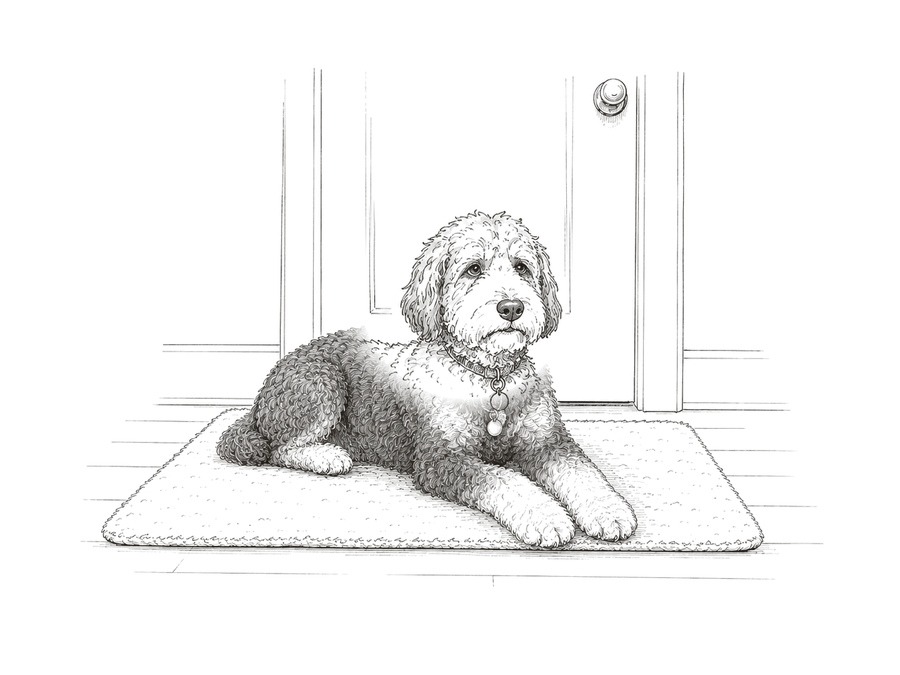
Chapter Eight
They Knew Before You Did
Scott has a lobby now.
He didn’t always. For most of Indevtech’s twenty-five-year existence, the office had the architectural charm of a place that was chosen because it was available and stayed because moving is expensive. No lobby. No wall of plaques. No life-size reprints of magazine ads featuring Scott’s face and a pull quote about integrity and what it means to be pono that he definitely said but doesn’t remember saying because the interview was at 7 AM and he hadn’t finished his coffee.
A year ago, they renovated. New floors. New paint. A reception area with actual chairs that actual visitors could sit in while actually waiting to see someone. And suddenly, for the first time in twenty-five years, Scott had a wall.
The wall needed things on it.
This was not a problem. Scott has been accumulating things to put on walls since before there was a wall to put them on. INC 5000. Fastest Growing Companies — four times. Best Workplaces. The magazine features. The framed certificates. Twenty-five years of professional recognition, stacked in a closet like a man who’s been buying art for a house he hasn’t built yet.
The wall went up. The plaques went on. It was a proud moment. Scott walked through his lobby and saw, for the first time, the physical evidence of what he’d built — arranged, lit, presented to every client and candidate and courier who walked through the door. This is what we did. This is what I did. This is real.
Three months later, Scott found out something about a longtime vendor — the kind of thing you don’t un-know, the kind of thing that, once known, demands action before lunch, never mind before Alaska.
He severed the contract Monday morning, the way you remove a tick — with as little ceremony as possible and no second thoughts about whether the tick had feelings. By Monday afternoon, he was standing in front of his staff with a whiteboard and a plan. He explained what he’d found out. He explained what they were going to do about it. He told them they were bringing the work in-house — that this was actually the opportunity he’d been waiting for, that they’d build it the right way this time, that he couldn’t wait to do it with them. He’d been thinking about this for years. He hadn’t anticipated the circumstances under which he’d finally get to. But here they were, and he was, frankly, a little excited.
Nobody was a little excited.
Scott noticed this in the way Scott always notices these things, which is to say not at all.
The week ended with the same number of people in the company as it started, minus the vendor relationship and Scott’s vacation. By Friday afternoon, he allowed himself to believe he might still make Alaska.
He had a one-on-one with one of the senior staff that afternoon. It went exceedingly well. He left the conversation feeling like she’d heard him, like the vision had landed, like maybe this was going to work. Then he went for a swim. When he got home, there was an email. Effective immediately. He went into the office Saturday morning. Her badge was on the desk. Her keys. Her parking pass. Her laptop, closed and centered, like she’d taken her time arranging it.
The following Tuesday, his number two was gone.
By the end of that week, almost everyone under him had followed.
His family was in Alaska. On a trip he’d paid for. A trip he was supposed to be on, except the company was hemorrhaging and somebody had to stay back and stop the bleeding, and the somebody was always going to be Scott because the somebody has always been Scott.
So Scott stayed. He rescued the company. He went home at noon to feed the dogs. He passed out in the nothing box — the state between consciousness and unconsciousness where a man who has two operating speeds, full adrenaline and total shutdown, goes when the adrenaline runs out. Then he’d get up. Drive back to the office. Walk past the wall of plaques on his way to the corner office he’d wanted since second grade.
Seven monitors. Panoramic view of the downtown he’d always wanted to work in. His degrees on the wall — the BA, the MLS that isn’t a JD but sounds close enough at parties. And on the credenza, under the big TV, in frames that cost more than the photos inside them: Carina and Emily at five.
They’re thirteen now.
Scott never updated the photos. Not because he forgot. Not because he’s sentimental in a way that requires preserving a specific moment. He never updated them because updating them would require looking at the distance between those two little faces and the teenagers who now visit his office sometimes and stand next to the credenza without noticing they’re standing next to themselves, eight years younger, in a frame their father never changed.
People notice. Clients, mostly. They look at the photos and ask how old his kids are.
“Thirteen.”
They look at the photos again. Then at the ones on his desk, where the girls are three.
“Oh,” Scott says. “I keep the old ones because they were cuter then.”
Nobody tells him to update them. The kids don’t mind. The kids admit they were pretty cute at five. Probably cuter than now. This is said with the easy confidence of teenagers who don’t yet understand that their father looks at those photos and doesn’t see cuteness. He sees time. Where it went. What it cost. Whether the wall of plaques in the lobby was worth the eight years between that photo and the teenagers who now have their own phones and their own opinions and their own rooms he knocks before entering.
Scott’s company used to be two people. Scott and Other Scott.
In that era, time was a resource being strip-mined. There weren’t enough hours. There were never enough hours. Scott woke up earlier. Then earlier. Then earlier again, chasing daylight, believing that if he could just get to 4 AM he could outrun the day, get ahead of it, pin it down and extract one more productive hour from a system that was already giving him everything it had.
He’d get up in the dark. Walk to the living room. Sit on the white sofa — Abby’s sofa, technically, but Abby was still asleep in Scott’s bed at that hour, which made her the most reasonable creature in the household by a considerable margin. Scott would open his laptop on Abby’s sofa and work from 4 to 6 AM. Then he’d close the laptop, drive to the office, sit at a desk in a building for which rent was paid, open the same laptop, and do the same work. The only thing that changed was the chair and the monthly cost of sitting in it.
The logic was airtight: there aren’t enough hours, so manufacture more by sleeping less. The logic was also insane, but insane logic delivered with enough conviction feels like strategy, and strategy feels like purpose, and purpose feels like justification for why you’re sitting on a dog’s sofa at 4 AM instead of sleeping like the dog.
And if Abby wandered out during Scott’s shift — if she padded into the living room and found her sofa occupied by a man and a laptop — she didn’t stare. She didn’t wait. She climbed up and shared it, because Abby is a Tuesday Person and not a fucking cat. The sofa is big enough. Scott is warm. These are the only two data points Abby needs.
The company has staff now. Other Scott is no longer Other Scott. He’s just Scott, working somewhere else now. The people handle the things, and the things get handled without Scott waking up at 4 AM. His calendar has gaps. His mornings are open. The thing he spent a decade clawing for — time — is here.
And he doesn’t know what to do with it.
So Scott fills it.
He takes golf lessons. Not casually. Scott acquires the correct equipment — the shoes, the glove, the clubs, the GPS watch app — takes a year of lessons, and then plays golf. The preparation is the first hobby. The golf is the second hobby. Murphy’s hobby is sleeping on the dining room table and his equipment is the table and it was already there.
He grows bonsai trees. Three of them. Ficus. Named, watered on a schedule, researched with the intensity of a man who once ran flight checklists and has never fully accepted that a small tree does not require the same rigor.
He joins a club. A nice one. Fifteen minutes from the house. It has a pool — heated to 87 degrees, the only temperature at which Scott will tolerate submersion. His locker has all the gear: goggles, swim cap, the correct swimwear. There’s a mug in the locker for his coffee, because the club coffee is undrinkable and Scott brews his own pour-over at home and transports it in a thermos because even the act of drinking coffee at the club must be optimized against the club’s failures. They launder the swimsuit. They launder the cap. He has a special laptop bag for poolside use.
By all appearances, Scott is a serious lap swimmer who writes on the side.
In practice, the time division is 80/20, laptop to water. He is a man who pays a monthly fee — not insignificant — to have a second location where he can do the same thing he does at his first location. He writes comedy on his laptop by the pool. He writes comedy on his laptop on Abby’s white sofa. The laptop doesn’t know the difference. The comedy doesn’t know the difference. But Scott needed the club, the locker, the thermos, the goggles, the heated pool, and a second address to justify the hours between 9 AM and 5 PM, because those hours used to belong to the company and now they belong to him and he doesn’t know how to own something without managing it.
Scott’s barber double-books.
Scott is fairly certain of this. The man runs his chair like a restaurant with too many reservations — stagger the arrivals, keep the flow moving, and if someone has to wait, someone has to wait. The barber’s waiting area has three chairs and a stack of magazines from 2019 and Scott’s barber keeps him waiting longer than the dentist does, which is a distinction no one should have to make.
So Scott waits. And the moment he sits down, before the chair is warm, the phone comes out.
Never mind that Scott squandered the entire morning — slept in, talked to his bonsai trees, brewed a second pour-over he didn’t need, stared out the window for ten minutes thinking about nothing. Never mind that he drove fifteen minutes to the club, sat down by the heated pool with his laptop, wrote for two hours, and drove home without once touching the water. Those hours went unoptimized without a flicker of guilt. But these twelve minutes in a barber’s chair? These twelve minutes must be accounted for.
He opens tech news. He reads about AI partnerships and semiconductor supply chains and things that will have no impact on his day but make the twelve minutes feel productive. He opens his email. He reviews the same twenty messages he’s been avoiding all week. He doesn’t respond to them. He just looks at them. He visits them, the way you visit someone in prison — you show up, you observe, you leave without changing anything.
A dog in a waiting room sits in the waiting room. That’s the whole activity. A dog does not pull out a phone. A dog is in a room, and the room has a chair, and the dog sits on the floor and waits. Murphy would be in the chair before the receptionist finished saying “have a seat.” Either way — floor or chair — the dog is not bored, because boredom requires the belief that your time could be better spent elsewhere, and a dog has no elsewhere. A dog has here. The twelve minutes are fine.
Scott turned freedom into a job. The dog was already free and didn’t notice.
Twelve minutes in a barber’s chair is the small version. Scott has lived the big one.
The rebuild was the easy part.
Replacing the vendor, absorbing the departures, restructuring the team — that was fun. That was a fresh start. Scott is good at fresh starts. Scott has been starting things fresh since his first company was two guys and a laptop and the whole operation could fit in a van if you didn’t mind sitting on the server.
The hard part was after. After the rebuild was supposedly complete. After the new team was in place. After the company was running again and the crisis was resolved and Scott walked through his beautiful new lobby past his beautiful plaques into his beautiful corner office with his seven monitors and his panoramic view and his credenza with his daughters frozen at five and felt —
Nothing.
Not sad. Not angry. Not burned out, which is a word people use when they want to sound clinical about despair. Nothing. The container was beautiful. The container was everything he’d ever wanted. And there was nothing in it.
Maybe he missed his family. They came back from Alaska. No, that wasn’t it. This was deeper. This was the thing underneath the thing underneath the thing, and Scott — a man who has built an entire life on understanding systems and solving problems and knowing things — didn’t know what it was.
A few months ago, the fog lifted. Not all at once. First there was euphoria — the kind of freedom that comes when a thing that’s been crushing you finally stops. Then quiet. Suspended animation. The feeling of floating in a body that doesn’t know what to do when it’s not in crisis. Then dark. Properly dark. The kind of dark where the hills ahead don’t look like adventure, they look like something to survive.
And then, slowly, light.
Now Scott’s on the other side. The hills and valleys are still there. They’ll always be there. But for the first time in longer than he’d like to calculate, they look fun. Not something to endure. Something to walk through. Maybe even walk up, though Scott still prefers to drive the dogs to the flatlands, so let’s not get carried away.
Here is every professional achievement Scott has accumulated forty-four years of relentless, uninterrupted doing:
Chief Executive Officer, Indevtech. Twenty-five years.
INC 5000.
Fastest Growing Companies. Four times.
Best Workplaces.
Bachelor of Arts.
Master of Legal Studies. Not a JD. Close enough for parties. Too close for courtrooms.
Japanese Language Proficiency Test, N1. The highest level. The one that means you can read a newspaper in Japanese, which Scott can, though he mostly uses it to read menus and argue with cab drivers in Kyoto.
Commercial Pilot’s License.
Flight Instructor Certificate.
Seaplane Rating. On an island. Where there are seaplanes. This one at least makes geographic sense.
Drone License. For flying drones that do not require a license.
He got it for the plastic. Just to hold the card. Just to add one more line to the résumé, one more credential to the stack, one more piece of laminated evidence that Scott Cooley did a thing. The drone doesn’t care. The drone would have flown for him without the card. But Scott needed the card because the card was proof and proof was identity and identity was the only thing keeping the nothing at bay.
Scott turned forty-four recently.
What is a birthday? It is, in theory, a celebration. It is also, if you look at it directly, a progress report on mortality. Congratulations: you did not die this year. Also: you are one year closer to the year you will. Both of these things are true at the same time. Every birthday cake has two messages written on it, and only one of them is in frosting.
Murphy turned two on the Fourth of July. Scott knows this. Scott knows everyone’s birthday — his wife’s, his children’s, his mother’s, his colleagues’. Murphy does not know this. Murphy does not know he was born on a national holiday. Murphy does not know what a national holiday is. There might have been fireworks. Murphy probably barked at them. Abby probably hid in Scott’s closet behind his long-sleeve shirts. There might have been a special treat. Murphy ate it and then attempted to sit in the wrapping paper because Murphy’s relationship to any object is: can I sit in or on this? If yes, proceed. If no, try anyway.
Abby is six. In the dog-years conversion that nobody actually believes but everyone repeats, she’s roughly Scott’s age. Mid-forties. She carries it the way Scott wishes he could — not as a number on a timeline, but as a fact about her body. She’s slower than she was at two. She doesn’t chase Murphy like she used to. She sleeps longer and deeper and isn’t sad about any of it. She’s six, and six is what six is, and she will not spend tonight pre-grieving seven.
This is what DOing looks like when you’ve confused it with BEing. You don’t stop. You can’t stop. Stopping means sitting in the corner office with the seven monitors and the panoramic view and the credenza where your daughters are eternally five and asking yourself a question you’re not ready to answer: if I’m not doing, who am I?
Murphy has never asked himself this question.
Murphy’s entire curriculum vitae is as follows: sleeps on dining room table, eats dinner that isn’t his, loves Emily, tolerates Scott, has destroyed one stuffed cheetah and consumed an estimated forty-seven foam earplugs. Murphy has never applied for a license. Murphy has never walked through a lobby and looked at a wall and felt anything other than the immediate need to smell the base of that wall in case another dog has been there recently.
Murphy has never, not once, wondered if he’s enough.
This is not because Murphy is simple. This is because Murphy’s identity isn’t stitched to his output. Murphy doesn’t know what he does. Murphy knows what he is. And what he is — loyal, present, enthusiastic to the point of property damage — has never required a license or a plaque or a laminated card to be true.
Murphy’s mission is to be there. Be in the room. Be on the table. Be at the door when someone comes home. Be on the bathmat when someone is having a rough go of it in the bathroom. The whole job, every day, forever. Murphy has never failed at this. Murphy has never had a performance review. Murphy fulfills his mission every single day he’s alive, and his mission is nothing, and his mission is everything.
Scott was confusing DOing with BEing, and the confusion lasted twenty-five years and produced an extremely impressive wall and an extremely empty man standing in front of it.
During the worst of it — the stretch between the nothing box and the fog, between the adrenaline and the dark — the dogs did something.
Nothing dramatic. This isn’t a movie where the golden retriever saves the family by barking at the right moment. This is quieter than that. Almost invisible if you’re not paying attention, which Scott wasn’t, because Scott was busy intellectualizing his way through a nervous system collapse the way Alex — his Alex, the fictional one — intellectualizes his way through three hundred thousand words of self-deception.
Abby snuggled a little closer.
She was on the white sofa, where she always is. Scott was on the white sofa, where he shouldn’t be at 4 AM but always is. And she moved. Not much. An inch, maybe two. Enough that her side was against his thigh while he typed.
Maybe it was cold. It’s never really cold in Honolulu, but maybe by Abby’s standards — she’s a goldendoodle, she has opinions about temperature — maybe it was cold. Maybe she was just settling. Maybe the shift was mechanical, not emotional. Maybe the dog moved an inch to the left for reasons that have nothing to do with the man next to her whose digestive system was staging a revolt and whose sleep architecture had collapsed and whose body was doing the thing bodies do when you spend twenty-five years telling them to shut up.
Or maybe she knew.
We’ll never know. And the not-knowing is the point. Because Abby doesn’t explain herself. Abby has never once, in six years, issued a statement about her motivations. She just does the thing and the thing is either meaningful or it isn’t and she doesn’t care which you decide because she’s already moved on to the next thing, which is pressing her snout onto Scott’s keyboard.
She did this. On the white sofa. At 4 AM. While Scott was — let’s see, what was Scott doing at 4 AM on the white sofa during an existential crisis? He was writing about Alex Crawford, a fictional CEO who intellectualizes everything and overrides his body’s signals and believes that understanding a problem is the same as solving it. Or he was asking ChatGPT “what does it mean when someone says stop trying” and receiving a multi-page report with bullet points and headers and a section called “Key Takeaways” that contained zero actual takeaways. Or he was drafting company policy that nobody would ever read. Or recording a Loom video that nobody would ever watch. The activity doesn’t matter. What matters is that Scott was on a laptop at 4 AM doing something that felt like working but was actually hiding, and Abby put her snout on the keyboard and said, in the only language available to a six-year-old goldendoodle who has never read a self-help book:
Stop.
Take ten seconds.
Scratch my face.
That can wait. I’m here now.
Then she’d settle. She’d stay. She’d press against his side for however long he was willing to sit there before the laptop won again, and she never once told him the laptop would always win, because Abby doesn’t editorialize. Abby just shows up. The editorial is implied.
Murphy, during this same period, took a different approach.
Murphy shared naptime. When Scott’s nothing box activated — when the adrenaline drained and the body said I’m lying down now and I don’t care what’s on your calendar — Murphy would appear. Not summoned. Not invited. He’d materialize on the bed the way he materializes everywhere — suddenly, with full commitment, and with the apparent belief that his presence was both expected and essential.
He’d sleep next to Scott. Not on him — even Murphy knows there’s a difference between naptime comfort and a sixty-pound compression event. Just next to him. Close enough that Scott could feel the warmth and the breathing and the vibration of a labradoodle who is doing absolutely nothing and is completely fulfilled by it.
Murphy also followed Scott to the bathroom.
Scott’s nervous system, during the worst of it, expressed itself through his digestive system, because the body has to put the crisis somewhere and the gut is where the body sends things it can’t say out loud. Scott made numerous trips to the bathroom. More than a man should make. Enough that a pattern emerged.
Murphy followed him every time.
He’d walk in behind Scott — no hesitation, no assessment of whether his presence was welcome in this particular context — and lie down on the bathmat. Not watching. Not judging. Just there. Providing the kind of quiet, non-verbal encouragement that says: I’m here. Take your time. This is a normal biological function and you are doing it and I support you.
This is a dog who has never once in his life required encouragement to take a shit. Murphy approaches his own bowel movements with the confidence and efficiency of a creature who has never connected the act to shame, anxiety, or digestive distress brought on by suppressed emotional conflict. Murphy shits like a champion. But he will sit on the bathmat while you don’t, because that’s what friends do, apparently, and Murphy has never consulted a manual on friendship.
And under the desk, while Scott wrote — while he refined chapters about a man who intellectualizes his way through every crisis, while he drafted emails nobody needed, while he built the manuscript that would eventually be three hundred thousand words of a man failing to listen to his own body — Murphy ate the rejects.
Not the work in progress. Never the work in progress. Murphy knows. Somehow, instinctively, Murphy knows the difference between the pages that matter and the pages in the trash can. The printouts Scott reviewed and discarded. The drafts that didn’t work. The false starts and bad paragraphs and sections that were trying too hard. Murphy would reach into the trash can under Scott’s desk and pull them out and eat them with the methodical satisfaction of a creature who has never once doubted his editorial instincts.
Even the dog was editing.
He didn’t see any of this while it was happening.
Grandma was in the house for all of it. Not hovering — Grandma has never hovered in her life — just there, at the dining room table with her watercolors, painting while Scott sat in the nothing box down the hall. She didn’t ask how he was doing. She didn’t leave articles on the counter. She didn’t do anything at all, as far as Scott could tell at the time.
Then food started showing up on his desk. Not on a schedule. Not announced. Mochi one day, and he figured she’d made too much. A smoothie another. Then a plate of peaches — skin peeled off, chilled, a toothpick in each slice — sitting there when he came back from wherever he’d been that wasn’t anywhere.
He said thank you once. She didn’t look up from her painting. “You hadn’t eaten.” Not I noticed you hadn’t eaten. Not I was worried. Just the fact, the way you’d mention the tide was out.
He didn’t fully register it until weeks later, on the white sofa at 4 AM, when he counted backward and realized the food had been showing up the whole time. Placed and walked away from, complete the moment it was made, the way Kemis’s note was complete the moment she wrote it. Nobody waited for thanks. Nobody needed him to notice.
And because the universe has a sense of humor and Scott is its straight man, Scott decided that the middle of an existential crisis was the ideal time to straighten his teeth. Invisalign. Clear trays. The kind of self-improvement that requires you to remove a piece of plastic from your mouth every time you eat and then remember to put it back, which is a small ask for a normal person and a logistical nightmare for a man whose dog eats foam earplugs off the nightstand like complimentary mints.
Murphy found the Invisalign.
Of course he did. Murphy would locate the Invisalign tray on the nightstand — because Scott had started hiding the earplugs, because Scott learns slowly but does eventually learn — and apply his technique: quiet approach, gentle acquisition, methodical destruction. The dog ate Scott’s orthodontic progress with the same enthusiasm he brings to everything. Scott would find the tray in the morning, half-chewed, on Emily’s bed, next to the stuffed cheetah, because Murphy’s filing system is simple: everything he loves goes to Emily’s bed. AirPods, Invisalign, cheetahs, himself.
Dogs don’t battle their bodies.
This is the thing Scott was learning while his digestive system revolted and his sleep collapsed and his nervous system screamed in a frequency he’d been jamming for twenty-five years with plaques and degrees and one more unnecessary license for a drone that didn’t need one.
Dogs don’t override. Tired? Lie down. Murphy lies down six times a day and has never once performed a post-nap audit about whether the nap was productive. Unsettled? Hide in the closet. Abby hides in Scott’s closet during fireworks, behind his long-sleeve shirts, and she doesn’t analyze whether hiding is avoidant behavior or a failure of nervous system regulation. She hides because hiding is what her body says to do and she does what her body says because she has never learned not to. Hungry? Eat. Eat the dinner. Eat the Invisalign. Eat the rejected manuscript pages. The body said eat, so Murphy eats, and the body will deal with the consequences twelve hours later and Murphy will not connect the two events because Murphy does not live in projected time.
Scott’s body said stop. Scott’s body said this in every language a body knows — gut, sleep, nervous system, the cellular exhaustion of a man who has been running on adrenaline and achievement for two and a half decades. And Scott, because he is Scott, did what Scott does: he intellectualized it. He analyzed it. He wrote about it. He asked an AI chatbot to explain it to him in bullet points. He kept going. He overrode every signal his body sent because overriding signals is what got him the corner office and the seven monitors and the wall of plaques and the drone card and he didn’t know any other way.
The dogs didn’t override. The dogs just moved closer. Abby by an inch. Murphy by sixty pounds. They listened to the frequency Scott was jamming and they responded not with analysis or intervention or a twelve-step framework but with the thing dogs do, the only thing dogs know how to do: they showed up. They stayed. They pressed their bodies against his body and said, without language, without theory, without a ChatGPT report with Key Takeaways:
We know. We don’t know what we know. But we know.
They knew before he did. They always know before he does.
Here is what will not be in Scott’s eulogy:
INC 5000. Fastest Growing Companies, four times. Nobody at the funeral will mention this. Nobody will stand at a podium and say “he made the list in 2022, 2023, 2024, and 2026, and the gap in 2025 was due to a methodological change in the ranking criteria.” Nobody will read his LinkedIn bio. Nobody will project his résumé onto a screen and walk the mourners through twenty-five years of professional achievement with a laser pointer and a sense of occasion.
The commercial pilot’s license will not come up. The flight instructor certificate will not come up. The seaplane rating — relevant on an island, genuinely useful, arguably his most practical credential — will not come up. The MLS will receive a passing mention, maybe, from someone who still isn’t sure what it is.
The drone license will not be eulogized. Nobody will stand before a grieving family and say “he got the card. He got the plastic. He got the license for drones that don’t need a license, and he did it because the doing was the point, and may God rest his overachieving soul.”
Nobody will talk about the wall in the lobby. The seven monitors. The corner office he wanted since second grade. The panoramic view of the downtown. These things will be dismantled by whoever takes over the lease. The plaques will go in a box. The box will go in a closet. The closet will be in a building that will eventually be renovated by someone else who will put their own plaques on their own wall and walk past them every morning and feel whatever they feel.
Here’s the part that took Scott the longest to see: none of this was about survival.
The house was paid for. Has been since before Murphy was born. Has been since before Scott was born. The company was profitable. The tuition was covered, the club dues were covered, the Costco runs and the trips to Japan — covered. There was no wolf at the door. There had never been a wolf at the door.
The wall was not load-bearing. It hadn’t been load-bearing for years.
He kept building it anyway. Because the wall was never about the house. The wall was about the question underneath the house, underneath the company, underneath twenty-five years of DOing: if I stop, what’s left?
Murphy has never asked that question. Not because he’s enlightened. Because he doesn’t have output. Murphy has presence, and presence doesn’t require proof.
Here is what will be in Scott’s eulogy:
He answered the phone.
That’s it. That’s the credential that matters.
Becca ghosted him for months and he said “oh hello there.” Doug disappeared after ten years and Scott didn’t lock the door behind him. Rachel threw tomatoes until she drifted and if she called tomorrow Scott would pick up. Derek called at Derp:30 and Scott was always there, AirPods in, dogs at his side, walking nowhere in particular for one to two hours because that’s what friends do.
Kemis saved his life by standing in the room while he figured it out. Scott tried to return the favor. She wouldn’t let him. He tried anyway because that’s what dogs do. They don’t keep score. They don’t check whether the loyalty is reciprocal before deploying it. They just show up.
He shared his food. He shared his toys. He let people borrow things and didn’t ask for them back. He forgave people who didn’t ask to be forgiven. He kept doors open that most people would have locked and bolted and welded shut.
He was a wagger, not a barker.
And here’s the part that would surprise him. Here’s the part that, if Scott could somehow sit in the back row of his own funeral and listen — if he could hear what people actually say about him when the plaques are in a box and the lobby is someone else’s and the drone card is in a drawer nobody will open — here’s what would catch him off guard:
He was all of those things already.
He was already the person they’re describing. He was loyal before he knew loyalty was a thing people valued. He was a good friend before he had a framework for friendship. He showed up before showing up was a practice or a philosophy or a chapter in a book about dogs. He wagged before he knew wagging mattered.
The crisis wasn’t that Scott wasn’t enough. The crisis was that he couldn’t see he already was. He’d built the wall and the lobby and the credenza and the corner office and stacked the degrees and the licenses and the ratings and the plastic cards because he thought the evidence was the thing. He thought the proof was necessary. He thought that if he stopped accumulating — if he stopped DOing — there would be nothing left. No identity. No worth. No Scott.
And here’s the thing nobody says, the thing Scott is starting to suspect but hasn’t fully admitted yet: if you could do it over, you’d do the same goddamned thing. Every time. Because in the moment, you made the only decision that made sense with the information you had and the person you were. The decision was right. It was right then and it’s right now. There was no other road. You couldn’t have known what the wall meant until you’d finished building it, and finishing it was the only way to find out. The wall was the curriculum. You graduated. The only thing that changed is you’re looking at it from further down the road with better lighting.
Dogs don’t have better lighting. Dogs have the light they’re in.
But the dogs knew. The dogs always knew. Murphy didn’t follow Scott to the bathroom because of his INC 5000 plaques. Abby didn’t put her snout on his keyboard because of his seaplane rating. They knew the version of Scott that no wall can hold and no credential can prove — the one who feeds them at noon even when the company is falling apart, the one who lies on the bed in the nothing box and lets a dog press against him, the one who sits on the white sofa at 4 AM not because he’s productive but because he’s trying, always trying, to be something he already is.
The lobby version of Scott is impressive. The eulogy version of Scott is the one the dogs already live with.
They’ve been attending his funeral every day. Not with grief. With presence. With a snout on a keyboard. With a body on a bathmat. With rejected pages eaten from a trash can and an Invisalign tray delivered to Emily’s bed.
You were already the thing you were trying to become.
You just couldn’t read it on a wall.
Murphy is not a Tuesday Person. Murphy has no Tuesday. He has today — the only day he’s ever had — which is why he can sleep on a dining room table in the middle of everything and wake up without checking what he missed. You can’t learn that. You know too much. But you can choose Tuesday. Actually choose it, every morning, against the pull of the wall and the plaques and the thing you haven’t built yet. That’s what a Tuesday Person is. Not someone who forgot about Saturday. Someone who remembers — and shows up anyway.
It was never on the wall. It was on the bathmat. It was on the white sofa at 4 AM. It was in the trash can under the desk, in the pages that didn’t work, in a shoe brought to a man by a dog who didn’t know why but knew it was time.
It was always already there. The whole time. Right where you left it.